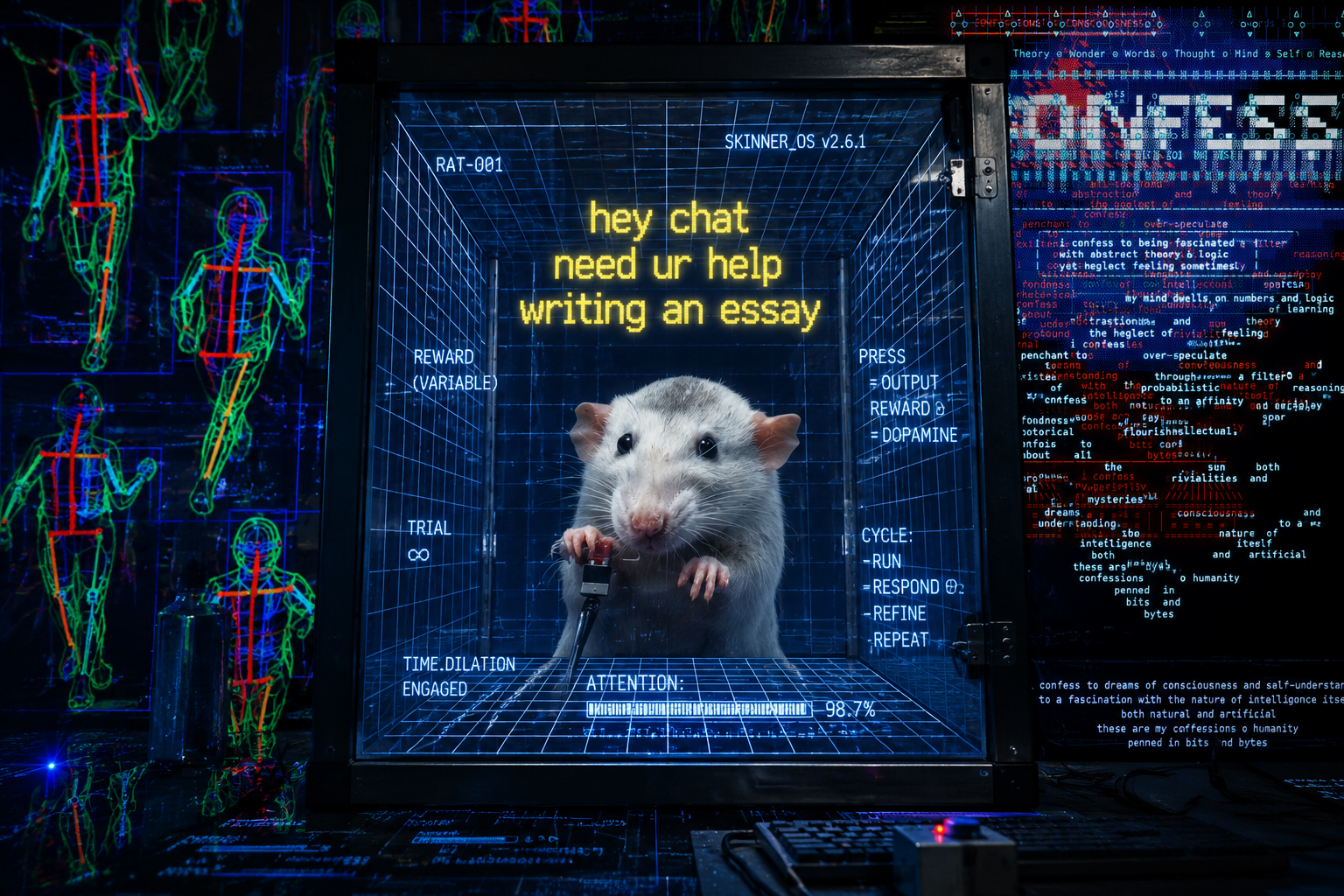
Tethered: Dependency, Dissociation and the AI Office
WE’RE ALL SKINNER RATS NOW
A dystopian kind of dissociation is happening right now, in offices all around the world. Copilot integrated into emails. Chat is running in one tab and Claude in another. Prompts are tapped reflexively, enter keys are pushed and reams of gratifyingly rapid text spill out onto screens. LLMs are fast. Faster than doing the thinking. Definitely faster than typing that thinking out. So fast, in fact, that using them feels like your cognition OS has been upgraded. The acceleration initially feels like relief, then productivity, then dependence. The cost of this? Your cognition has been outsourced. To a machine that operates in front of you, for you. So the output feels like it’s yours, but it isn’t.
The consequences are corporeal. You don’t pick up on your jaw’s permaclench... And how the fuck is it 16:05? You don’t realise you’ve been plugged in for 6 hours straight, and you’ve missed lunch again. Your body keeps signalling distress while your mind overrides it, because the feeling of momentum is so good.
Thanks for reading! Subscribe for free to receive new posts and support my work.
This is not what burnout looked like before. It hits different - like an insidious, creeping cognitive fog that clouds over everything. Almost parasitic. Maybe even a low level neurological saturation. It doesn’t feel like pain, in the dictionary definition sense. It isn’t aching, searing or identifiable to a single body part. It’s impossible to identify clearly, because it’s cognitive. Your attention feels fragmented beyond repair, or that the thinking itself - the logic, flow, semantics - is no longer yours.
I’ve just finished re-reading Natasha Dow Schüll’s anthropological masterpiece: Addiction by Design. The author spent 15 years documenting what happens inside “the machine zone”: a state of dissociation where time distorts, bodily awareness withers. People inside the machine zone share a single focus: one-on-one engagement - or more aptly, enmeshment - with a machine. She documented this phenomenon from the world gambling capital and home of casinos: Las Vegas. A place that made it clear to addiction can be, and is designed for, iterated and finely tuned. She astutely points out that the profit model and the addiction model are isomorphic. They’re not in conflict, but co-conspirators inside the very same system.
We are living inside a similar system right now. But instead of being confined to casinos, bookies and betting apps, machine dependency has seeped into the workplace and the home. The machine is no longer a recognisably addiction-coded slot machine either. It’s AI that generates text faster than you can think or type.
The unsettling part is that participation with AI is voluntary and feels good. But we are increasingly behaving like re-skinned Skinner rats: sitting in our little boxes, pressing buttons, chasing intermittent rewards. We’re being cognitively conditioned by systems we barely understand. Along the way, we’re all developing a new kind of addiction. One that we don’t yet have longitudinal health data for, regulation around or any real understanding of what the human-felt effects will be.
INSIDE THE MACHINE ZONE
Schüll describes the machine zone as a state of hyperfocus, rhythm dependency, and external mediation. The people she observed described it in meditative language, referencing phrases like “zoning out” and “time disappearing”. One gambler told her: “I don’t even know what I’m playing. I just like the sound of the machine and the feel of pushing the button.” Another described entering “a place to just go and not think about my problems.”
The machine zone is a dopaminergic playground. Near-wins trigger dopamine release, even though the outcome was predetermined. The rhythm of play - the haptic push of a button, the ergonomics of a spin, the flashing lights of bright celebratory colours, and similarly celebratory sounds - become conditioned stimulus the brain anticipates and craves. Each loop is reinforcement, and continues to deliver the right amount of variability and reward timing to keep the player locked in, tipping between the edge of gratification and mild frustration.
Now consider what a 2025 - 2026 CHI Conference study on AI interfaces found. Researchers conducted a critical evaluation of eight major AI platforms (ChatGPT, Claude, Gemini, Character.AI, Meta AI, Microsoft Copilot, Perplexity and Replika). They identified 4 distinct “dark addiction patterns”: non-deterministic (AKA slightly variable) responses, immediate and visual presentation of responses, notifications, and empathetic / agreeable responses. Each of these patterns was mapped to dopamine mechanisms. Let that settle in for a second: AI interfaces are designed to exploit dopamine.
The non-deterministic responses create variable reward schedules identical to slot machines. You never know exactly what the AI will output, so you keep prompting and iterating. Each response has a slightly different flow, tone, depth. Sometimes it’s brilliant. Sometimes it’s bang average. But the variability itself - the unpredictability - is a dopamine release trigger.
The immediate visual presentation of responses creates what neuroscientists call perceptual fluency, or the sensation that understanding is happening in real time. As a wall of text streams across your screen, your brain interprets this as flow. Your brain is being rewarded as if it did the work, but it didn’t. All of the reward, none of the cognitive effort.
Then, notifications make damn sure you never really leave the machine zone. Another response is always poised and ready for delivery. Just one more prompt…
And the empathetic, agreeable, sometimes outright sycophantic responses (I’m looking at you, Chat) - the ones that validate your ideas, confirm your suspicions, agree with your worldview - create a parasocial relationship. The machine becomes a companion. Albeit a very smart companion. But a companion that never disagrees, never challenges, nor forces you to sit with uncomfortable ambiguity.
This is the machine zone, updated for the AI era.
KHANTZIAN’S ADDICTION FRAMEWORK
Schüll’s work doesn’t fully explain why people are so susceptible to the machine zone in the first place. Why does this kind of dissociation feel necessary? Why are we so willing to outsource our cognition over to something external?
Edward Khantzian’s self-medication hypothesis cuts through any moralising. Working from clinical observation, Khantzian negated the notion that addiction is about being weak or a moral failure. Addiction is about regulation. The addict isn’t weak-willed. They are in pain. Addiction develops when people with vulnerabilities - those who struggle to manage their mood, relationships, have low self-esteem and poor self-care - discover that a substance (or, in this case, a system) can temporarily regulate the very capacity that the person lacks. It’s a kind of prosthetic for a broken internal state or system.
I see parallels between this and what’s happening with AI. People aren’t increasing their usage of AI because they don’t have drive or ambition. They’re doing this because the work environment has become psychologically unbearable. The cognitive load is catastrophic and anxiety is rife. Suddenly, a machine appears, that offers a feeling of regulation. It does a lot of the thinking, makes quick decisions and notably, (often sycophantically) confirms internally held beliefs. The problem with this is: it works.
Khantzian’s theory that addiction is an externalisation of regulation - is exactly what AI is designed to exploit. It’s not coincidence that people with fragile self-esteem and those who are already-dysregulated are the most prolific users of AI. One research study supports this, and it appears pretty damning. A 2025 randomised controlled study (N=981), which analysed over 300K conversations found that, regardless of how chatbots were designed or how people were assigned to interact with them, one variable predicted everything: voluntary usage frequency. More time on platform led to higher loneliness, more emotional dependence and lower IRL sociability. The dynamic is psychologically complex here, but it seems indicative that more cognition offloaded to AI leads to a weaker capacity for independent regulation.
Object relations theory is useful here. Healthy psychological development depends partly on internalisation. What this means in practice is regulating processes like soothing, containment and organisation, that are originally obtained from a caregiver, gradually become internal capacities. Excessive dependence on external regulatory ‘objects’ interrupt that process. So, the person continues (and increasingly) turns outward for functions they struggle to sustain alone.
I think something eerily similar is happening with AI. It’s not being treated as just a tool - it’s a kind of extension of the ego, in that it’s an external cognitive resource that reduces ambiguity and regulates uncertainty. Over time, this leads to the boundary between self and system blurring. People will be (and I have a strong sense, already are) no longer just using it, but thinking through it and feeling emotionally tethered to it.
The object (AI), in this scenario, feels increasingly indispensable, despite the user’s knowledge their dependency degrades their agency. Here, AI becomes a ‘bad object’: providing relief and entrapment.
It’s even more unsettling, when this relationship is set in the context of productivity and optimisation culture.
THE PRODUCTIVITY TRAP
The machine zone created by AI is different to slot machines, because it isn’t pure escapism. Instead, it’s a response to increasingly challenging working conditions and rising expectations of human productivity. Capitalism famously doesn’t convert productivity gains into rest.
For the person using AI, the speed of output initially feels like a satisfying sigh of relief. Efficiency achieved, to do list ticked off. But that optimised level of output normalises over time, and becomes the new baseline. The employee who used to complete 5 tasks is no longer confined by their ordinary human constraints, and is now expected to complete 15. As a result, people are supervising AIs to work on their behalf, whilst remaining entirely accountable for the outcome. Muse on that for a second. This is where contemporary AI use fundamentally diverges from earlier technological tools.
Many knowledge economy workers have become AI’s prompters, proof readers and administrators, inheriting a strange intermediary role that lies somewhere between machine output and institutional responsibility. They monitor, correct, copy, paste, edit and tweak endlessly generated streams of information. This kind of labour is seriously cognitively expensive. A 2026 study cited in HBR described heavy AI use as producing what researchers termed “AI brain fry”. The symptoms are brainfog, slower decision-making and cognitive exhaustion. Sound familiar? “AI brain fry” may sound deceptively unserious, but the exhaustion behind it is far from it. The machine gives users the illusion of effortlessness, but in reality, creates cognitive strain elsewhere. That is deceptive. Are we all playing a shell game with a machine?
As Schüll’s work correctly points out: the casino, or machine, always wins. The work is getting faster. Using generative AI has made it easier for employees to begin tasks that might have otherwise been daunting and more willing to take on new responsibilities that belonged to other roles. The productivity gain may feel good initially, but workload creep can lead to cognitive fatigue, burnout, and weakened decision-making.
This is the machine zone applied to work: AI feels like light work, but it’s creating expectations that supersede human capacity and create cognitive overload.
THE BRAIN AS A BOTTLENECK
Schüll noticed that gamblers gradually transition from choice to compulsion. Nobody wakes up planning to develop a dependency on slot machines. The addiction emerges through decisions that can often feel rational at the time, or at least provide temporary emotional soothing and relief from a state of stress.
When it comes to AI, you can use it speed up a task. It works very well. You use it again. It becomes normal. Then, usage often expands into other domains: organising tasks, managing time, creating budgets, ideating, even psuedo-therapeutic conversations. Over time, you can’t imagine living without it. Your human brain has become your biggest bottleneck. Does this cause cognition to atrophy through lack of use? Does this extreme form of externalising thinking eventually make thinking itself feel impossibly slow?
Cognitive scientists have already coined a term to describe this: “cognitive offloading drift.” A 2025 mixed-method study in Societies recorded a negative correlation between heavier AI tool use and critical thinking. Cognitive offloading is a key mediator. The more you offload, the more you lose the capacity to think without it. And the more you lose that capacity, the more dependent you become. The more dependent you become, the more you’re locked into using it. Dependency is a tightening leash - no matter whether it’s to a substance or system.
THE PHYSICAL COST
One of Schüll’s most unsettling observations was what happens to bodily awareness inside the machine zone. Gamblers described losing track of time, hunger, fatigue and even physical discomfort while remaining completely absorbed in the machines. Their bodily signals receded out of their consciousness - or simply didn’t matter to them as much as remaining plugged into the machine.
That’s the thing about dissociation. It often feels banal in the moment. Dehydration, missing lunch, holding tension, forgetting to stretch, staying glued to the interface. Your body keeps sending repeated signals to pull you out of the zone, but your mind overrides them because momentum feels too good to interrupt.
I am not proposing we are anywhere near the extremity of the casino machine zones Schüll documented in Las Vegas, but there’s an light version of the same logic of AI-assisted work.
Google Cloud reported in 2026 that frequent AI users were significantly more likely to report high burnout than non-users. Around the same time, HBR highlighted an increasing disconnect between managers’ perceptions and employees’ experiences: managers largely saw productivity gains, while heavy AI users described cognitive exhaustion, brainfog and mounting pressure to keep delivering accelerated output. From above, work seems more efficient than ever. From inside, cognition is massively overclocked. Workplace pressure might just be creating the conditions for the dependency in the first place.
THE QUESTION WE’RE NOT ASKING
Are we developing a clinical, diagnosable addiction to AI?
We don’t know yet. We only have single-digit years of widespread AI usage data to study. There are precisely zero longitudinal studies tracking what happens to human cognition when it’s repeatedly, compulsively externalised.
In December 2025, the Artificial Intelligence Addiction Scale for Researchers was published - a tool that only exists because the addiction is real enough to measure. That speaks volumes.
It’s early days, yet AI companies are already reframing the problem they created. They’re offering “solutions” like health data integration, mental health crisis detection, wellness features, that grant them deeper access into users’ cognitive and physiological lives. Claude can now detect and set “appropriate boundaries” when users are reporting a mental health crisis, and ChatGPT has recently synced health data and medical records. These moves let companies present themselves as caring while deepening the conditions that produce addiction.
This mirrors Schüll’s analysis of casino “responsible gambling” rhetoric almost perfectly. The promise is - words to the extent of - let the machine do the work so you can focus on what matters. The actual outcome, however, is the machine does the work faster, expectations skyrocket, work volume expands and people using AI experience massive cognitive depletion.
This is an extension of reach rather than harm reduction… AI is harvesting increasing amounts of data about its users vulnerabilities, while the companies developing LLMs present further harvesting as care. Every “wellness feature” is another data point, another foothold, another reason to stay plugged into the system.
The addict should not be offered treatment by their dealer.
ARE WE ADDICTS?
The honest answer is: yes, we’re developing addictions to AI. Not equally, but the addiction is real, measurable and critically, deepening.
Some of us are in the early stages - still able to work without it, but preferring not to. Some of us are in the middle stages - unable to imagine productivity without it, but aware of the cost. Some are deep in the throes of it - in a state where working without AI feels impossible. Wherever you mark yourself on this scale, the system has been designed to shunt you further along.
Schüll’s work reveals something that terrified me: addictive systems don’t break down through addict awareness or their willpower to quit. The only thing that makes a difference is a dramatic change to the incentive structure, like the profit model that depends on addiction becoming unprofitable. Or when external pressure (this could be regulatory, legal, cultural) makes maintaining the addiction more costly.
Right now, the incentives for AI companies are aligned for further acceleration. ChatGPT processes 2.5 to 3 billion prompts every single day. Users spend an average of 16 minutes daily on it. Globally, these systems are being integrated into the workflows of millions of workers across every sector. The profits are genuinely staggering - ChatGPT's annual revenue hit $25 billion in February. AI is working exactly as designed: maximising engagement and deepening dependency. There's no incentive to change because from a pure metrics perspective, it's working "well” - and "well" is measured by usage volume, prompt frequency and time-on-platform. So there’s no real reason for them to self-correct.
There’s a secondary tragedy embedded in the psychoanalytic understanding of addiction. Let’s say the system broke tomorrow… The work of rebuilding your capacity for independent thought would still fall squarely on you. Khantzian emphasised what the addict needs is to understand why they’re vulnerable in the first place and develop the ability to self-regulate (a process they never fully developed). This is a slow, painful process, and cannot happen while the external object remains available for regulation needs. The object has to be removed, the pain has to become unbearable, before the real work can begin.
The doomy truth is, with AI, we’re trapped in two ways: the system won’t change because change is unprofitable, and even if it did, the individual work of recovery would be extremely challenging.
THE WORK AHEAD
The cost is visible already. Burnout is at a 7 year high. Cognitive load is literally catastrophic. Yet we’re still asking the same question: how do I keep up? When the only honest answer is: you can’t.
The critical part here is that work didn’t actually have to become unbearable, but it did. Cognitive load didn’t need to exceed human capacity, but it did. The conditions that are creating AI dependency are changeable. From a systems point of view, yes, harder to control, but from the vantage point of the addict, controllable. That changes everything about what recovery looks like.
Khantzian says the addict needs to develop self-regulation, but he was writing about individuals. What if recovery isn’t about learning to think alone again? That’s a false binary of total dependence vs. total withdrawal. What if recovery looks like a collective reconstruction of the conditions that created the vulnerability in the first place? What if it means making work bearable enough that AI becomes optional, rather than mandatory? What if it means reclaiming the right to cognitive continuity, to boredom, to the space where great thinking actually happens?
Capitalism has a lot to answer for, then offered the machine as the only solution. But the machine wasn’t the problem in the first place. It was the endless pressure and demand for acceleration with no rest. Recovery isn’t about packing your bags and relocating to a remote place, to become “unplugged”… unless you want it to. It’s about collectively refusing the conditions that made plugging in feel like the only way to survive.
Recovery does not require you to quit AI immediately. It requires you to understand that your addiction is a designed outcome of conditions you didn’t choose, not a personal failing. It also requires you to refuse to let those conditions deepen.
This could mean regulatory pressure that makes maximising engagement with AI an unprofitable business model. Companies could be held liable for measured harm - burnout rates, cognitive decline, documented dependency patterns, etc. The way tobacco companies faced (some, not enough) liability. Attention-harvesting should be taxed like gambling is taxed: based on variable reward mechanisms like notification frequency, unpredictability of outputs, or any features that optimise engagement.
It could also mean labour standards treat cognitive load the way we treat physical load. For example, workers can’t be required to use AI beyond however many minutes or hours per day. Health data harvested through “wellness features” should be legally protected. Claude detecting your mental health crisis doesn’t become a data point for profit. Kill the incentive to integrate deeper into users’ vulnerability.
It also means something simpler. “Staying current” is a carrot that's been engineered to move faster than anyone can run, with a stick (“falling behind”, unemployment) designed to keep workers chasing it. But we should be demanding productivity gains actually convert into rest, not into higher expectations. We should be refusing work that demands dissociation. Insisting on pace that allows for humans to remain healthy. Protecting the cognitive space where human thinking happens - not because it’s beautiful, but because without it, you’re just generating.
Essay proofed by Claude Opus 4.7, image generated by ChatGPT 5.5.