Pop Music: Our Emotional Oracle
------------------------------------------------------------------------------------------------
Before the chaos of 2025 descended on me, I worked on a project involving unpacking the public personas of Taylor Swift, Charli XCX and Sabrina Carpenter. What started out as a simple strategy exercise quickly became a Jungian descent into the collective unconscious. It’s lived in my mind rent-free ever since.
Although Taylor, Charli and Sabrina’s individual personas reveal how contemporary artists construct identity, emotion and spectacle, they are parts in a much larger cultural machine.
------------------------------------------------------------------------------------------------
POP MUSIC ISN’T JUST CULTURE REFLECTIVE. IT’S CULTURE GENERATIVE.
Over the course of the past 50 years, mainstream pop music has been more of a public mood board than just entertainment. Or maybe it’s closer to a kind of cultural seismograph?
Because pop has global reach and an unusually intimate relationship with its audience, you could call it a reflective index of cultural sentiment. It shapes identity, social behaviour, cultural and aesthetic norms. Cultural theorists and scholars in adjacent fields widely accept that pop operates in a feedback loop, where cultural meaning informs music production, and artists / producers / labels / trends in the music industry subsequently reconfigure cultural meaning. So, pop doesn’t just reflect the cultural mood: it sets it, generates it, accelerates it, and has the power to totally derail it.
Practically speaking, the industry and players within it detect shifts in collective emotional tremors before they hit the surface:
- Brat was a pre-emptive cultural diagnosis of the boredom of self-optimisation, therapy speak and moralisation / virtue signalling fatigue
- Cowboy Carter gleaned that genre = authority early on, at a time when national identity was collapsing and history was being rewritten aggressively
- West End Girl was more than just a personal narrative of heartbreak and humiliation. Lily Allen cycles between breakup grief, retrospective Stepford wifery and present tense blunt self-assertion. She negotiates autonomy, desire, and social expectation at a time when women are questioning and Vogue is covering whether: “having a boyfriend is embarrassing now.”
Pop doesn’t just soundtrack cultural change. It registers it early, translates economic conditions, political tension and shifting ideas of selfhood into sound, image and persona long before those changes are named elsewhere. It’s actually measurable in one way: scholars have observed that economic health is correlated to stylistic and sounds of pop releases. When the economy is tanking, artists are generally more lyrically introspective and sonic style becomes minimalist (think repetitive patterns, ostinatos and a steady pulse). When the economy is booming, music follows suit with maximalist sound, celebratory lyrics, and so on. Across the decades, pop music can be used as a tool to track the public’s psychological weather of the moment:
Pop Optimism:
- The late 90s and its economic boom gave us the Total Request Live era, defined by squeaky clean boyband choreography (think NSYNC, Backstreet Boys) and glossy pop-princesses (Britney, Christina, obvs). Their high production slickness made these pop stars feel more like protagonists of culture / world builders.
- 2010-2014 was the era of post-recession pop and EDM euphoria. Calvin Harris, David Guetta and Rihanna (particularly ‘We Found Love’) served up songs that were way more than just upbeat - they were an ecstatic overcompensation for the austerity of precluding years. Predictable 4x4 beats, wrapped in synths gave us nostalgia and futurism, which tied the comforts of the past to an idealised future.
Sonic Anxiety:
- The rise of melancholic, minimalist synthpop coincided with the 2008 global financial crash (think Lana Del Ray, Lorde etc.). This genre paralleled the emotional precarity that went hand-in-hand with financial precarity.
- In the past decade or so, we’ve entered an era defined by hyperconnectivity, digital fatigue, chronic stress and parasocial intimacy. FKA Twigs and Caroline Polachek, amongst others, have released a number of tracks with ASMR adjacent vocals… Sounds that produce a false sense of proximity to each artist and physiologically soothe nervous systems of the chronically online. Similarly, we see upticks in whispering vocals when people are stressed: bedroom pop and whisperpop boomed during the pandemic (Billie Eilish, Gracie Abrams etc.), aligning with themes of withdrawal / domesticity / burnout.
Riot Pop:
- The obvious inclusion is, of course, late 70s to early 80s pop punk and the post-disco rebellion. Economic malaise, political unrest and the cultural friction of the late 70s spawned a rebellious streak in pop music (think Blondie and The Clash). Blondie’s ‘Heart of Glass’ fused disco sound with punk attitude, signalling that rebellion could coexist with mainstream appeal. It was about attitude, irony and challenging social norms of the time, not necessarily pure sonic aggression.
- The 00s gave us pop-punk and amp-pop (Avril Lavigne / Green Day / Paramore). It channelled adolescent frustration and suburban angst into melodic tracks with mass appeal. At the time, teens were highly tribal, and exploring digital connections through early social networks like Myspace. In this context, rebellion looked like expressing personal alienation whilst critiquing societal expectations.
INFLUENCING IDENTITY
Tween and teens use pop as entertainment, but it’s much more than that. Pop functions as a developmental tool for identity formation. Angela Robbie’s seminal work on girls’ culture demonstrates this and calls music a “training ground” where femininity is learned and contested.
Pop stars offer persona templates that give girls an opportunity to experiment with the kind of person they want to become, without an obligation to commit to anything. Back when I was a teenager, Britney’s early work like ‘Sometimes’ and ‘Born To Make You Happy’ expressed saccharine compliance. A sort of yearning and pleasing ‘perfect girl’ identity. This version of her gave girls a trial-run to internalise people-pleasing, approval-seeking and ultimately, externalising validation.
When Britney embodied sweetness, Christina Aguilera was all about vocal excess and sexual assertiveness. Her smash hit ‘Dirrty’ was hyper-sexual, sweaty and aggressive. She was the living embodiment and proof that being provocative is a form of female agency. Importantly, she encouraged girls to reject moral policing and judgements. Pink, too, rejected the TRL era pop-princess mould. Instead, she cultivated a nonconformist aesthetic of baggy cargo pants, bleached short spiky hair and overt sarcasm. Lyrically, she declared her opposition to both normative femininity and consumerism, particularly in tracks “Most Girls” and “Don’t Let Me Get Me”, which both featured themes of refusing to seek male validation. Ultimately, she was a template for girls who didn’t want to be cute or compliant.
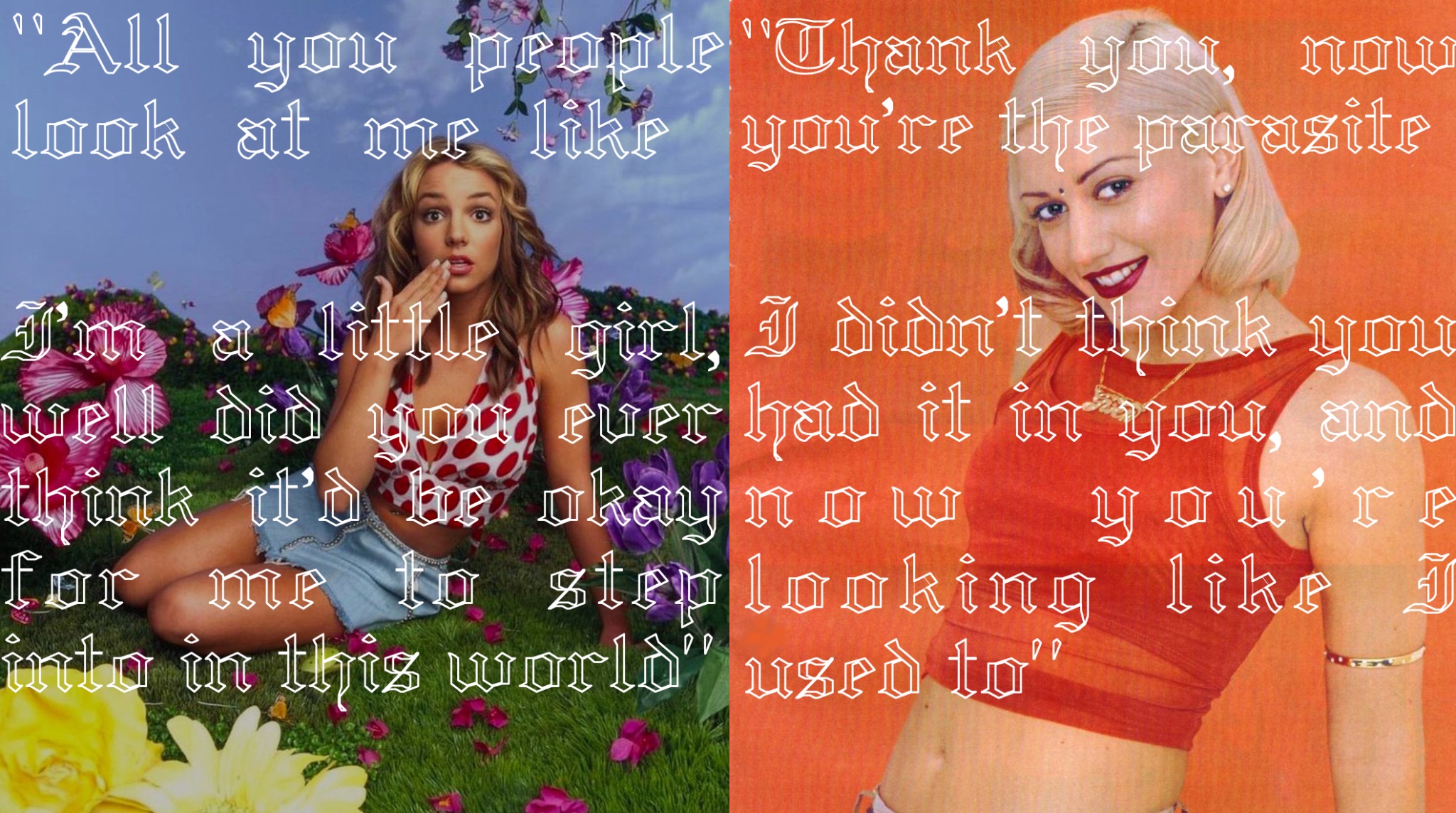
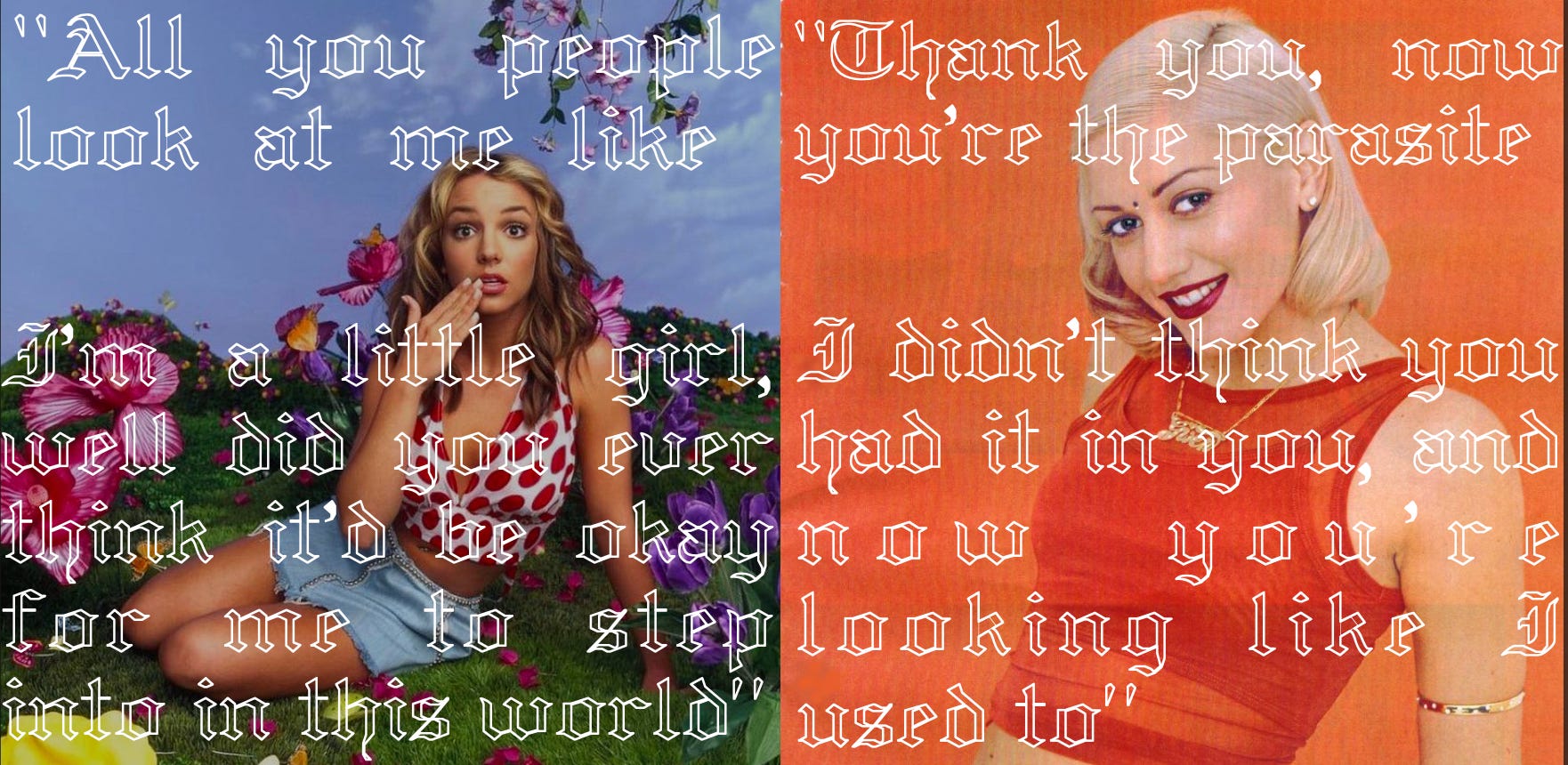
When she left No Doubt, Gwen Stefani was giving maximalist misfit energy. Harajuku appropriation aside - formative, but not OK - she modelled a rebellion that was aesthetic, playful and all about intentional excess. ‘Just A Girl’ was a sarcastic anthem full of pure feminist frustration. It named the cage so girls could see the bars, with lyrics like: “don’t let me drive late at night” and “they won’t let me in, unless I’m in that dress”. She playfully labelled the everyday micro aggressions and patriarchal policing, and blew these up into a satirical bop. She hinted at questions girls and the queer community feel innately, but may not have named at that age, like: “why are the rules different for me?” “Why do boys get freedoms I don’t?” “Why is my safety my responsibility?” “Why am I expected to be mild-tempered about it?” Interestingly, Gwen doesn’t fall into a clear archetype (good girl / bad girl). She was girly and furious. She straddled being soft and sneering. She gave young girls and the queer community a liberating message: you don’t have to stop expressing who you are to be angry, because rebellion doesn’t need to be masculinised. One of the core reasons Gwen was so successful in this era was because she dared to weaponise girlishness to expose unsaid truths.
Her attitude and vibe forms part of the lineage that runs through Charli XCX, Doja Cat, FKA Twigs: all of them share similar indignation, self-definition and refusal, expressed in their own signature styles.
Pop music also articulates how to feel and operate in the world through direct personal statements, rather than observations of others. Lyrics are rarely abstractions. Pop lyrics feel porous - they’re vague enough to be universal, yet intimate enough to seem confessional. This first-person delivery makes lyrics uniquely easy to project onto. The listener doesn’t interpret. They inhabit. All the listener needs to do is insert their own internal monologue. In this way, pop is unlike other mediums of the arts: literature often requires distance, and cinema situates feeling within a narrative body, and this wider context prevents such strong projections, as detail proves the lives of protagonists are not necessarily similar to the viewer’s own.
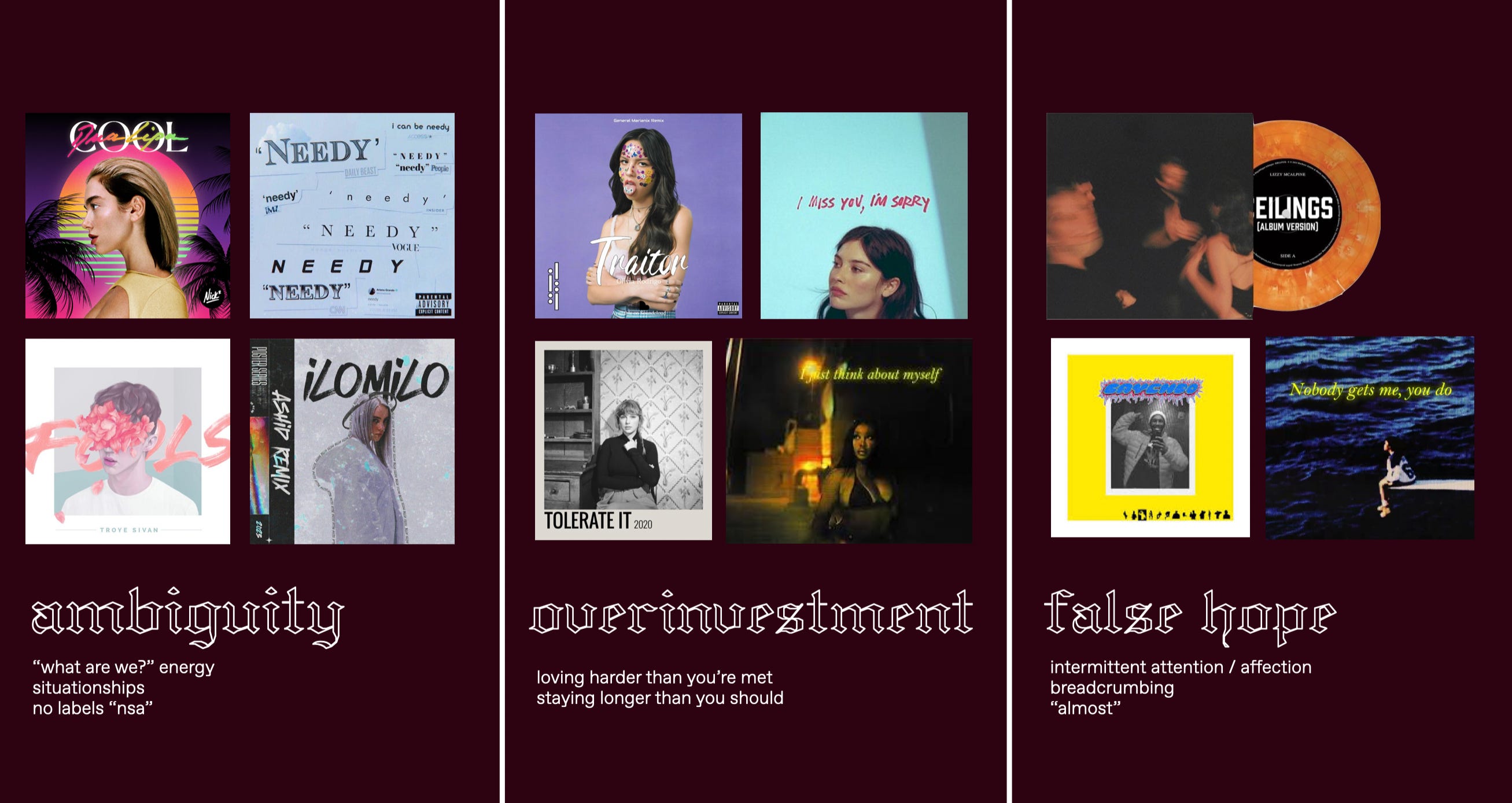
This might make pop sound inherently manipulative. It’s not. It does, however, make it extremely powerful. It trains people not only how to feel, but how to act whilst feeling. It compresses complex relational processes into verse length clarity, which makes it extremely behaviourally buyable - especially when you’re not sure what to say or how to act.