
Part II: Pop As A Transitional Object
------------------------------------------------------------------------------------------------
My first piece explored how pop music sets the cultural mood, rather than just reflecting it. This piece turns to the pop star, and why personas like Sabrina Carpenter provoke such polarised reactions right now. The controversy *isn’t really* about how she looks, or what she says. It’s about desire, power, control, irony, anxiety, and ultimately, what we are not comfortable seeing women perform publicly.
------------------------------------------------------------------------------------------------

During periods of personal transition, pop music offers emotional containment without requiring explicit resolution. In the moments where identity has been destabilised: adolescence, breakups, reinvention, grief, etc. Unlike reality, pop doesn’t ask for coherence. Instead, it enables the listener to hold onto conflicting emotions - or internal objects - at the same time.
This matters because most transitions are psychologically paradoxical in nature. It’s not uncommon to miss someone who tore you apart. It’s definitely possible to feel grief and relief simultaneously. You can want independence and still crave attachment. Western cultures (particularly North American and Western European cultures) have a habit of framing contradictory emotional states as personal instability, confusion, weakness or simply failure. Pop, however, normalises emotional contradictions by staging them.
In a very Winnicottian sense, pop operates as a ‘transitional object’. Something external that acts in aid of people who need to regulate internally, whilst moving from one psychic state to another. The listener isn’t forced to choose a single emotion. They can oscillate between them safely and on their terms. Ultimately, pop enables listeners to externalise internal conflict. Instead of carrying paradox privately: “I still love him” vs. “I deserve better”, pop distributes that conflict across tracks, eras and artists. One song might focus on devotion. Another might carry rage. Crucially, neither invalidates the other. Together, they form a psychological holding space. This function is particularly important for people leaving destabilising relationships or identity structures.
When reality demands decisiveness, pop provides a parallel space where ambivalence is not only permitted, but can be rewarded:
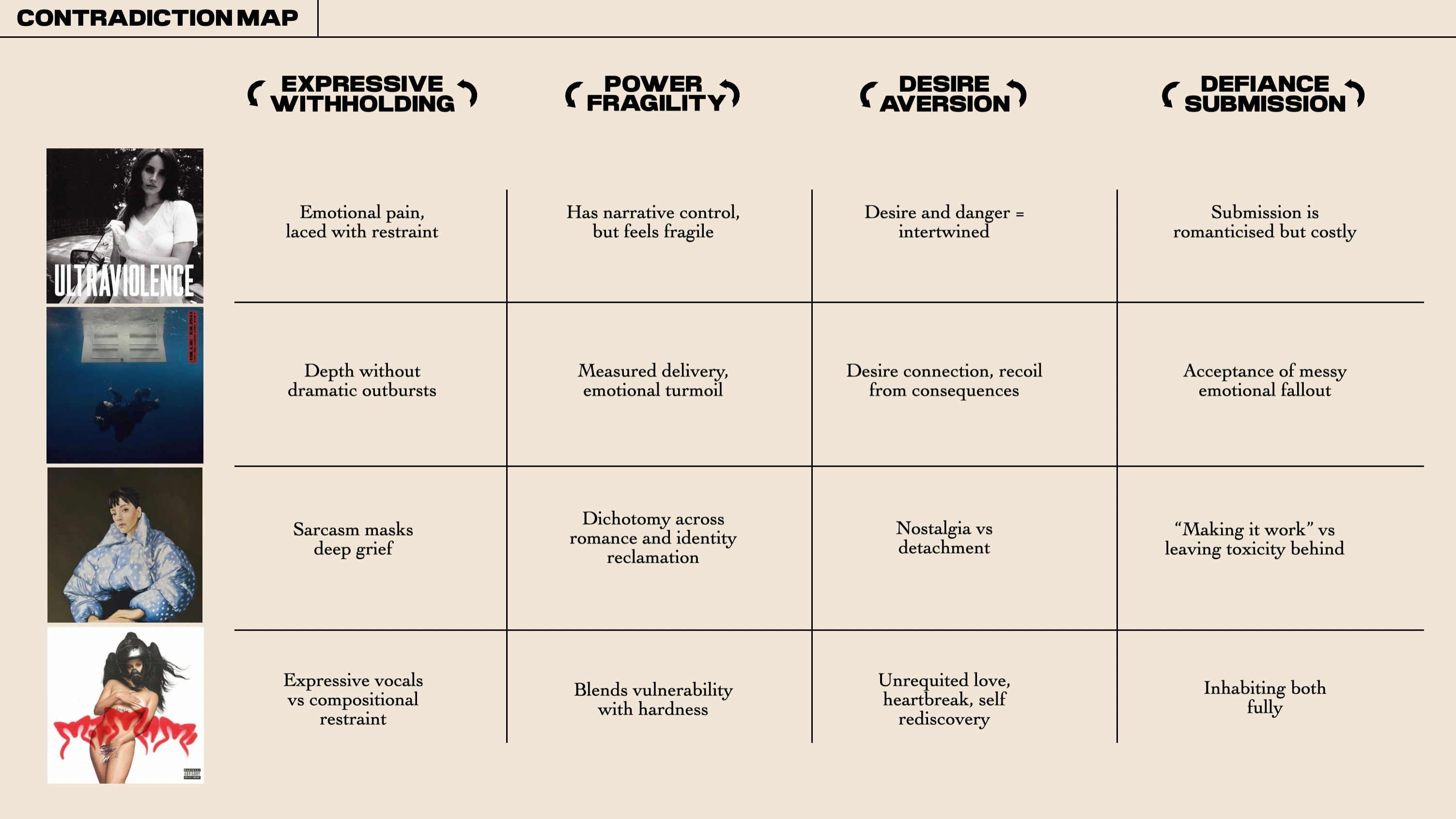
- Lana Del Rey romanticises submission, whilst critiquing it and exposing its cost simultaneously. Perhaps the most brutal example of this is the lyrics: “he hit me and it felt like a kiss” in ‘Ultraviolence’.
- Billie Eilish expresses numbness and intimacy in the same breath. Lyrics like: “when I’m away from you, I’m happier than ever” / “try not to abuse your power” / “I don’t want it, and I don’t want to want you” all echo emptiness and desire, intertwined.
- Charli XCX can boomerang between hyper-independence and emotional exposure, without falling into incoherence.
- Taylor Swift’s catalogue as a whole expresses this. ‘All Too Well’ allows the expression of grief to be honoured, whereas tracks like ‘Clean’ or ‘I Forgot You Existed’ are emotionally distant without eradicating past truths.
- Lily Allen’s ‘West End Girl’ is a compilation that cycles through the shared heavy emotions that lace any breakup. On top of this, she expresses the ups and downs of “trying to make it work” with rawness and vulnerability, the raw defiance of leaving an addict, and the melancholic nostalgia of mourning a version of a past self, that loved and was contented.
- Rosalía’s ‘Motomami’ is literally a duality: Moto symbolises raw power, hardness, speed and Mami is soft, nurturing, vulnerable, intimate. The album bends genres and explores themes of unrequited love, heartbreak, self-discovery and transformation, taking listeners on twists and turns of conflicting emotions around every corner.
- Ariana Grande’s ‘ghostin’ and ‘thank u, next’ sit in tension with one another. ‘Ghostin’ is sonic loss and mourning, whereas ‘thank u, next’ reframes loss as growth. Listened to in sequence, they validate two core truths of transition: healing is non-linear and selfhood is not corrective, it’s cumulative.
In these examples, contradiction is archived rather than resolved. Each emotional position exists as an artefact and all artefacts are equally legitimate.
Pop’s ability to hold paradox is amplified by its structure. Songs are short, repeatable and often rhizomatic. They aren’t narratives that demand closure - a listener can loop heartbreak in the morning and empowerment in the evening, without feeling a sense of internal contradiction or conflict. This mirrors the reality of the way in which humans process emotion far more accurately vs. the tidy arcs that culture expects. Rather than resolving contradiction, pop accepts, enables and rewards emotional multiplicity. It reassures listeners that being internally split does not mean being broken, but instead, in transition.
This phenomenon matters on a larger scale. This era of fractured timelines, unstable attachments and prolonged liminality is relationally destabilising for many - particularly women. In this context, pop’s refusal to adhere to emotional singularity makes it culturally adaptive. It gives people psychic support while they re-negotiate who they are, what they want and what they will no longer tolerate. Unlike self-help culture - which so often insists on clarity - pop provides companionship in uncertainty. Unlike social narratives - which demand clean exits and empowered endings - pop archives the mess. Paradox is so often pathologised. But pop simply turns it into a chorus to sing along to.
THE CULTURAL FEAR OF CONTRADICTION
So, if western cultural norms often treat contradictions as deficits, yet humans are emotionally multiplicitous, and conflicting emotions are all too often pathologised… What does this lead to? Cognitive dissonance en mass. Why? Because holding onto multiple coexisting yet contradictory emotions or internal objects, simultaneously, is inherently uncomfortable, and all too often - to add insult to injury - openly judged. Those who embody ambiguity or contradiction are publicly criticised, labelled unstable, indecisive, erratic or emotionally immature.
- Inside the world of wellness, emotional states are medicalised or optimised: anxiety = dysregulation, sadness means a low vibration, anger is just “blocked energy”, and ambivalence is “misalignment”.
- The self-help industrial complex equates relational dynamics with moral decisions. Popular mantras like: “if it costs your peace it’s too expensive” / “you attract what you tolerate” / “choose yourself” expose this clearly.
- The social media machine algorithmically incentivises consistency over contradiction: one aesthetic, tone of voice, identity and emotional position = winning.
These all implicitly mandate the resolution of paradoxes. In doing so, they encourage people to reject parts of themselves in favour of presenting a linear, coherent sense of self into the world. Pop music, however, platforms conflicting emotions and desires. In doing so, it legitimises people’s internal paradoxes. Ambivalence is acknowledged and aestheticised, instead of being erased from existence.
CONTAINING CONTRADICTIONS: OBJECT RELATIONS THEORY
Through the lens of object relations theory, lived experience is structured by internalised relational templates. What this means is, from childhood, we all learn to navigate desire, attachment and selfhood through interactions with primary caregivers and primary objects. Early patterns give form to the relational expectations, roles and fantasies that continue on into adulthood, which shape both platonic and erotic relationships.
Object relations substantiates that the psyche contains multiple internal objects, which act as psychic representations of others and of ourselves. Internal objects are held in tension, and operate dynamically. When a child develops healthily, they can shift between internal objects and comfortably contain contradictions internally. But this capacity is limited. When relational or erotic energy is charged, or in other words, presents multiple activating forces all at once (sweetness and sexual magnetism, attachment and independence, etc.), the psychic system struggles to integrate them. In any given interaction or relationship, more contradictions = more object structures drawn on. This fires affective circuits simultaneously, that might feel viscerally contradictory.
This struggle happens on two levels: individual and cultural. Individually, we often project internal conflicts onto partners, erotic objects or fantasies - reactivating developmental templates and mirroring early relational dynamics. For example, someone who was rewarded for assertiveness but shamed for their desire may find it both intoxicating and destabilising when a partner embodies these qualities. Culturally, these contradictions are reflected and amplified in pop culture, media and social norms. We are all trained to categorise and feel desire, attachment and reflection separately. So, when a real or fantasy person integrates all three IRL, our culturally conditioned cognitive schemas struggle to keep up. Put simply: an overload of contradictory internal objects produces both fascination and psychic overload. Celebrities play with these tensions, giving audiences opportunities to practice containment, play out desire and explore relational multiplicity safely.
SABRINA: A SHARED PSYCHIC OBJECT
Within this landscape, Sabrina Carpenter’s music is of particular interest, because to me, she’s symbolic of contradiction’s productive potential. ‘Skin’ or ‘Because I Liked A Boy’ perform desire, regret and empowerment all at once. They refuse a singular, emotional truth and allow listeners to feel the same way. ‘Nonsense’ oscillates between playful flirtation, self-confidence and then vulnerability. It not only legitimising ambivalence, but makes it pleasurable too.
Sabrina has become one of the most culturally polarising erotic objects of the 2020s. Objectively speaking, standing at five foot nothing, she’s a tiny little button. Her look is hyper-pornified, but she also looks like the kind of woman Disney would grow in a petri dish. The artwork of ‘Man’s Best Friend’ was particularly self-objectifying and raised a lot of hackles. It visually fused girlishness, a knowing glance, and hyper-sexualisation (for those who haven’t seen it: she’s kneeling in front of a guy’s crotch, who’s tugging on her dishevelled hair). But many of her lyrics contradict her look and aesthetic, signalling high agency and irony.
It’s useful to acknowledge the intense cultural turbulence in which she’s risen to global fame and notoriety. Feminist discourse has flooded mainstream media. Conversations about autonomy, self-awareness, consent, erotic agency, internalised misogyny and power dynamics are common parlance. On the flip side, the ideology of the manosphere has grown into a significant, amorphous mass that’s increasingly radicalised, counter-current and normalising of contempt for and violence against women. It reframes male aggression as a biological imperative and female sexuality as something that must be policed, or worse, punished. This simultaneous amplification of feminist theory and reactionary misogyny has created an environment where public projections are rife, and female celebrities who perform sexuality and engage in overt eroticism become lightning rods for both sides’ projections. In this cultural climate, Sabrina Carpenter isn’t just a pop sensation. She’s a highly projective object for an entire culture on the brink of a gendered meltdown. This is why she provokes such intense and often contradictory reactions.
Gender politics have become explicitly adversarial. Carpenter’s persona plays to both sides of the battleground. She’s infantilised yet agentic. Pleasing yet withholding. Lyrically dom yet aesthetically sub. Has high satire self-awareness that’s wrapped in hyper-feminine softness. Deftly blends childlike playfulness with adult, erotic competence… She embodies a number of opposing internal objects at once, and people respond intensely to that. This is precisely why Carpenter is so compelling to this cultural moment. Because of her playful contradictions. She’s a pop star who plays with tension, edge and bite - which makes her the perfect object for projection.
SWEET, SEXUAL AND SELF-AWARE - WE CAN’T HANDLE ALL THREE
Culture, too, has a habit of organising relational qualities into distinct categories that feel incompatible. Sweetness is safe, maternal, comforting. Sexuality is instinctive, destabilising, excessive. Self-awareness is reflective, rational, restrained. It’s rare that three objects like these can coexist in one subject. At least without producing high levels of discomfort.
From an object relations perspective, this difficulty is expected. As above, the psyche doesn’t experience others and otherness as a unified whole, but as constellations of internal objects (formed developmentally). Children learn to ‘split off’ objects, by emotion or feeling. For example, a child might hold onto: the caring object, the erotic object, the judging object and so on. These splits protect the child, allowing them to manage overwhelming emotions that arise by mentally separating the incompatible qualities from one another. Integration comes later. Even into adulthood, it remains fragile.
Let’s focus on sweetness, sexuality and self-awareness as a simple taxonomy. Each of these qualities activates a different internal object. (Whilst this differs across individuals, based on their developmental lived experience, I’ll attempt to be as universal as possible here): let’s assume that:
- Sweetness evokes attachment, safety and early dependency.
- Sexuality activates desire, disinhibition and risk.
- Self-awareness is all about reflexivity and enables being observed, seen, heard, assessed, known, loved.
When all three are experienced simultaneously, multiple objects must be mobilised… And nervous system chaos descends.
Culturally, we are trained to manage this overload by flattening one or more objects. Sweetness without sexuality is cosy and sexuality without sweetness is hot. But throw the two in together, and familiar power dynamics are destabilised. This phenomenon is often experienced as unusually compelling or activating, sometimes unsettling. An individual who is sweet, sexual and self-aware does not allow for desire to remain uncomplicated. They cannot be idealised without threat, or eroticised without attachment. For most people, this kind of interaction demands a tremendous amount of internal integration. As a result, people and personas who embody multiple contradiction provoke polarised responses.
THE SPECIFICS OF WHY WE CAN’T HANDLE SABRINA
Sabrina Carpenter operates in pop culture as a symbolic surface her audience can project their own fantasies, anxieties and unresolved relational templates onto. She’s not potent because of her novelty. She’s potent because she draws on familiar archetypes whilst destabilising them. Her public persona embodies deeply embedded patterns of femininity, desire and innocence, which her audience recognises, identifies with, eroticises or rejects. Her performances often embody dichotomies of control and vulnerability.
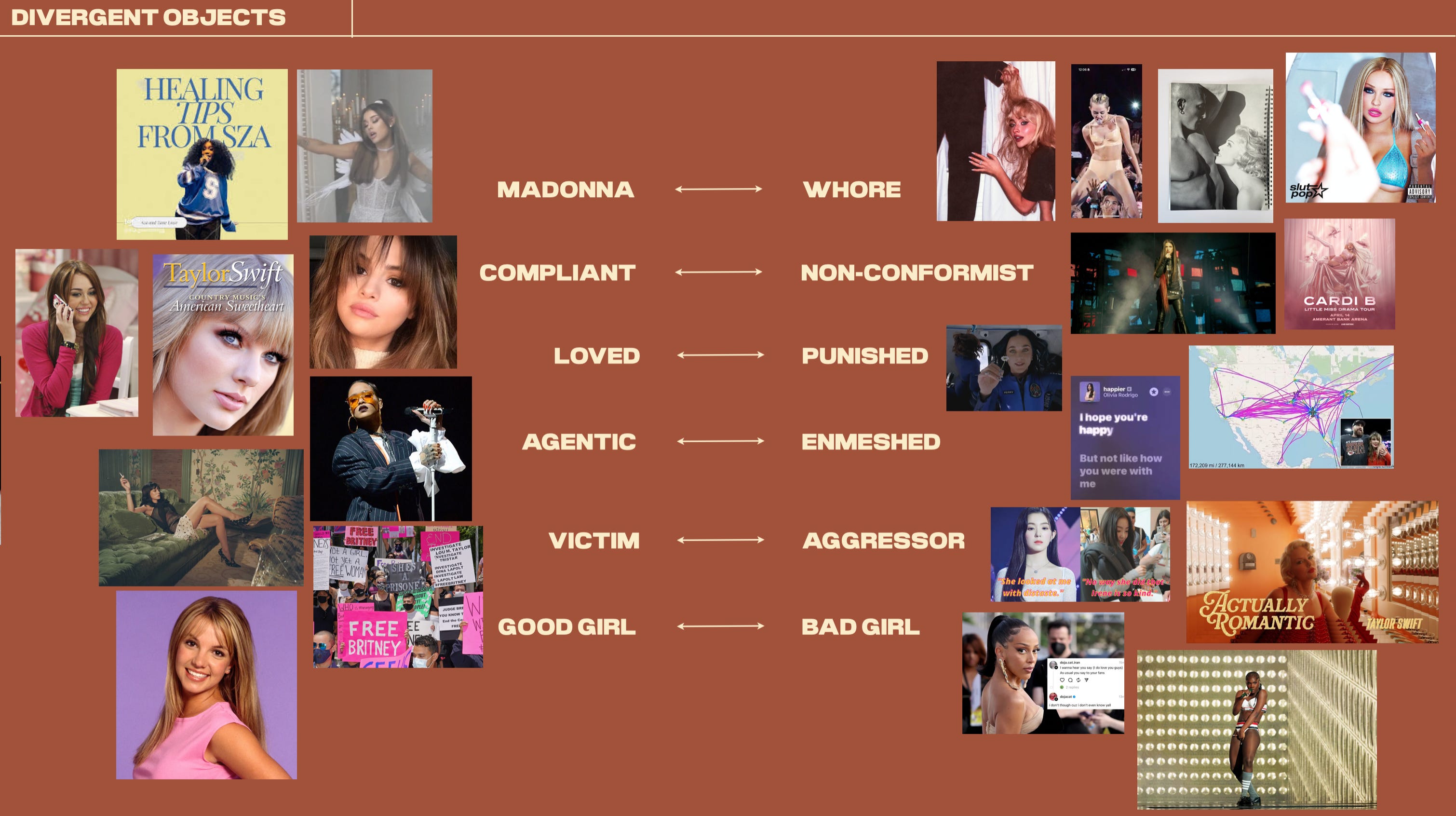
For many women, Carpenter embodies contradictory internal positions they are encouraged - by culture itself - to split off. Women can identify with her as both the subject and object of desire (to feel wanted and to want). She represents relational templates where femininity is not just passive / reactive, mothering / childlike, agreeable / accommodating, Madonna / whore. Instead, she dips into differing archetypes and expresses paradoxical affects, strategically playing with her audience’s internal objects. She does not attempt to resolve any of her contradictions. Instead, she inhabits them fully. Through projecting onto her, women are able to hold onto fantasies, desirability, agency and vulnerability without being forced to reduce to a singular position Carpenter is a container for ambivalence, and she seemingly enjoys embodying these contradictions, which adds a layer of aspiration.
For men, she activates idealisation or threat via moralisation or domination. Her self-infantilisation alongside overt sexual agency creates an impactful split across (traditional) categories of desirability: she is approachable and safe, yet erotic and autonomous, all at once. Because Carpenter embodies these contradictions, the internet tells me a tiny minority idolise her, but a large subset of men respond to her with dismissal, criticism or outright hatred. She violates the mental schema they rely on for desire that feels legitimate. Dismissal or vilification from men onto women are often defence projections. So, by devaluing her publicly, men attempt to restore their sense of control over relational and sexual dynamics.
For queer fans, ambivalence is instrumental. Many queer individuals grow up negotiating family dynamics, social circles and environments that enforce rigid norms around gender, sexuality and how to relate to others. Carpenter’s innate multiplicity mirrors the complexity of queer identity. Because Carpenter refuses to assume one singular position, she is highly relatable as someone who rejects normative scripts. And her sarcastic, self-aware humour feels like a shared code - a way to decode and engage with her persona that validates ambivalence and emotional fluidity.
The intensity of response to Carpenter’s persona - from parasocial relationships to public outcry - can be understood when viewed through the lens of splitting. By actively resisting being sorted into distinct objects in the minds of her fans, she destabilises the psyches of those who are unable to integrate her contradictions. As a result, these fans resolve their discomfort by splitting her instead. There are a number of articles that frame her as empowering vs. exploitative, self-aware vs. delusional, a feminist icon vs. regressive fantasy designed for the male gaze, and so on. These binaries say less about Sabrina Carpenter’s persona, and far more about haters’ and fans’ inability to contain contradiction or ambivalence. Which is why the conversation around Sabrina Carpenter fractures across gender and ideological lines.
Notably, Sabrina isn’t a passive actor. She’s an active player. Constantly pushing against categorisation, she doesn’t just provoke splitting - she promotes it. You could say she holds up a funhouse mirror to the developmental tensions that remain in so many people’s minds, even into adulthood.
As well as splitting, Carpenter’s persona engages something called object constancy: the capacity to maintain an emotional connection to an internal object, even when it is absent, ambiguous or incites uncomfortable reactions like anger. Object constancy, develops early. It’s the internal force that enables children to tolerate separation anxiety and hold onto the idea that their caregiver is “good enough” even when they are not available (physically or otherwise). This is a fundamental to becoming a securely attached adult.
Carpenter is an interesting case study, when cast in this light. Like many celebrities, she’s consistent in tonality, but inconsistent in access. What makes her unique is her humour: by winking at the audience / breaking the fourth wall, she frames desire as ironic and playful. As a result, listeners feel like they’re in on the joke, which strengthens internalisation. So, she becomes an object that can be summoned emotionally - through listening to songs, watching interviews, consuming content etc. - even though she isn’t responsive or physically present.
For audiences with fragile object constancy, which is intensified by digital culture, intermittent reinforcement and unstable attachment norms; this dynamic can tip into obsession. Obsession looks like Carpenter becoming a stable internal object in the context of a wider, relationally chaotic landscape. Her contradictions, therefore, do not disrupt attachment and instead, deepen it. Her oscillations between availability and withholding, intimacy and distance, sweetness and sexual dominance actually keep the internal object alive and emotionally charged. This is how parasocial relationships form and are maintained. This explains why Carpenter, and many pop icons, inspire fixation which leads to fandoms. Fans - especially those feeling destabilised - use pop personas as transitional figures. In exchange, they feel a sense of emotional containment without the need for linear continuity.
In short, Sabrina doesn’t offer clarity; she offers containment. This is, in my view, exactly why she is unbearable to some, irresistible to others, and ultimately impossible to ignore.