Manosphere: Powerlessness As Performance
----------------------------------------------------------------------------------------------------
Last week, I tuned into Louis Theroux’s ‘Inside the Manosphere’. The ideology is grim, but by now, not exactly surprising. What was more revealing was the psychological make-up of the men inside it. They all look and act like slightly different versions of the same person: wounded, defended and in full performance mode. Like little boys in oversized masculine drag. That’s the real tell: how transparently these men wear their defences on their sleeves, while desperately trying to pass them off as truth, authority and strength… Their BS is familiar. Their fragility isn’t. This piece decodes that fragility.
----------------------------------------------------------------------------------------------------
The manosphere is no longer fringe. It once read as a niche, tragic internet subculture, contained within equally niche, tragic platforms like 4chan. Its figureheads were caricatured as bedroom-bound, socially excluded incels, hidden behind anonymous avatars. That archetype has now been replaced. The contemporary face of the manosphere is hyper-visible, strong-minded and performative. He’s physically disciplined, financially affluent and fluent in how to game the algorithm. His messaging hasn’t softened, but he’s received a major rebrand. That matters, because how he presents alters how the ideology is received. What once read as bitterness now reads, to many, as aspiration.
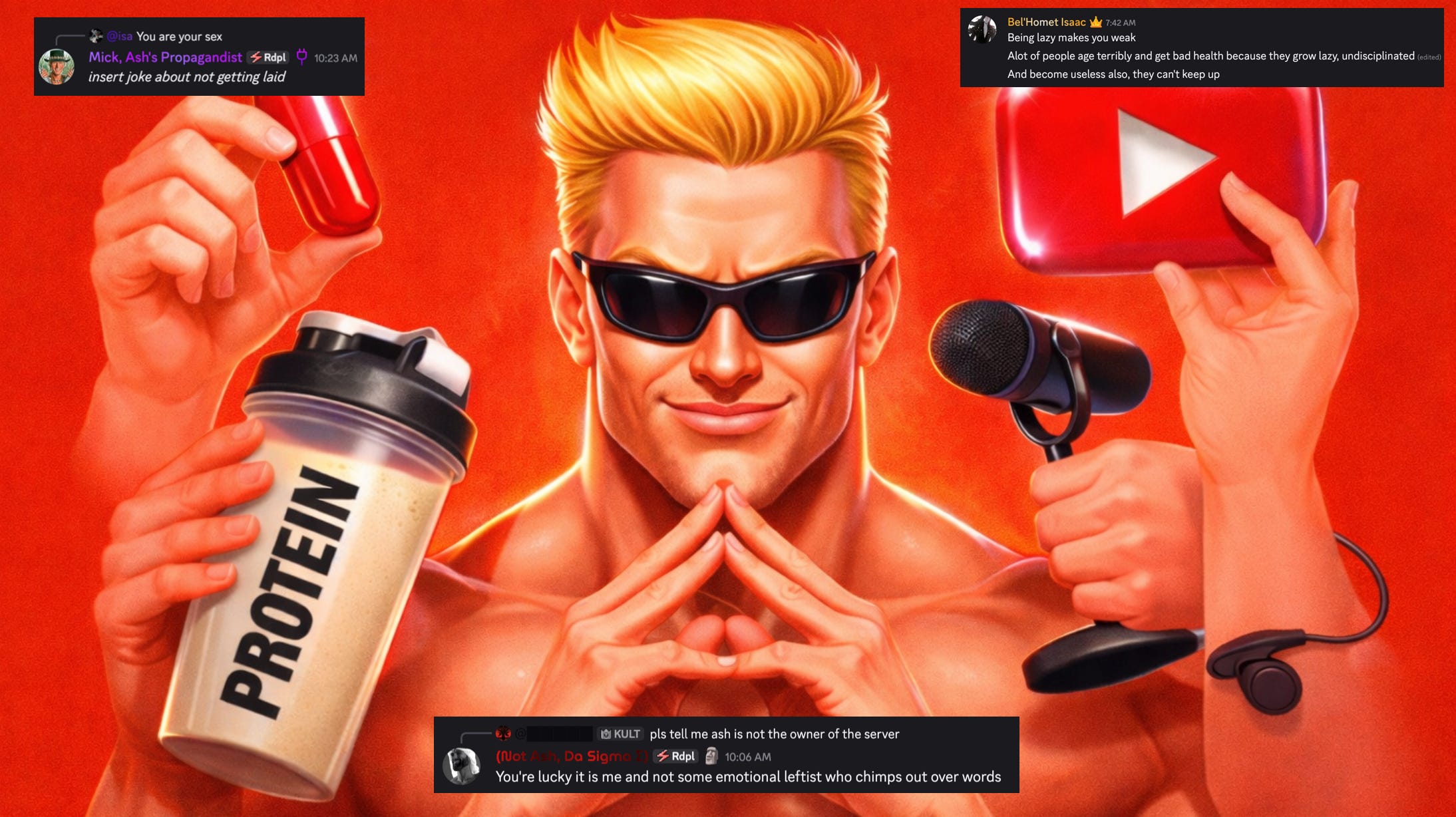
For young men trying to find their footing - to locate themselves socially, sexually, economically - this shift is significant. The new figureheads don’t just talk about success, they embody the manosphere’s version of it. Theirs bodies are optimised, their lifestyle is visible, their access to women appears effortless (“one-sided monogamy”), and their confidence is performed as fact not fiction. They overtly offer a sense of direction, but covertly they are promising a stable identity. A way of moving from uncertainty into something that looks - at least from the outside - like coherence.
This is why the entry point feels so deceptively benign. It often begins with self-improvement: how to get fit / how to make money / how to be more attractive / how to “win”. Embedded within that is a more rigid logic:
- Validation = earned externally
- Status = ranked against others
- Belonging = conditional
- Connection = something to secure vs. developing sustainably over time, with consistent effort / showing up
The packaging may have changed, but the underlying structure hasn’t. Neither has the rhetoric. The manosphere operates less like a depraved subculture and more like a niche layer of culture itself. It’s spilled out from the confines of forums into podcasts, TikTok, YouTube, livestreams - often reframed as “truth”, “discipline” or “male empowerment”. And you can see it in its spillover effects.
The Tate brothers’ repeated de-platforming feels almost theatrical - like a perverse game of Whack-A-Mole, where they keep re-emerging elsewhere with greater influence and reach.
The same ideological tone bleeds into politics too. The re-election of Donald Trump isn’t reducible to manosphere ideology, but the shared language is impossible to ignore: grievance, entitlement, the sense that something has been unfairly taken and must be reclaimed.
At its most extreme, the consequences stop being theoretical. In the UK, the 2024 case of Kyle Clifford - who consumed Andrew Tate content shortly before murdering his partner, her sister and their mother - forces a far more difficult question into view. What happens when these ideas are not just consumed, but enacted?
Culture has started to grapple with this. The TV drama Adolescence traces how these narratives can take hold early, mapping a trajectory from confusion and insecurity into something far more destructive. And in Inside the Manosphere, Louis Theroux captures something subtler but equally telling. Not just the beliefs themselves, but the way they are performed. In his encounters with manosphere creators like Sneako and HS TikkyTokky, conviction and performance abound. At times, even the suggestion of violence becomes part of the content cycle: something to be clipped, circulated and rewarded with engagement.
The scale of concern reflects how embedded this has become. Schools, parents, policymakers are all trying - often clumsily - to respond. What’s becoming increasingly clear is that this isn’t just a content problem. It’s not simply a few bad actors or harmful messages that need moderating (although more scrupulous moderating is sorely needed). It’s a system. And it’s one that is becoming more persuasive and pervasive than ever before.
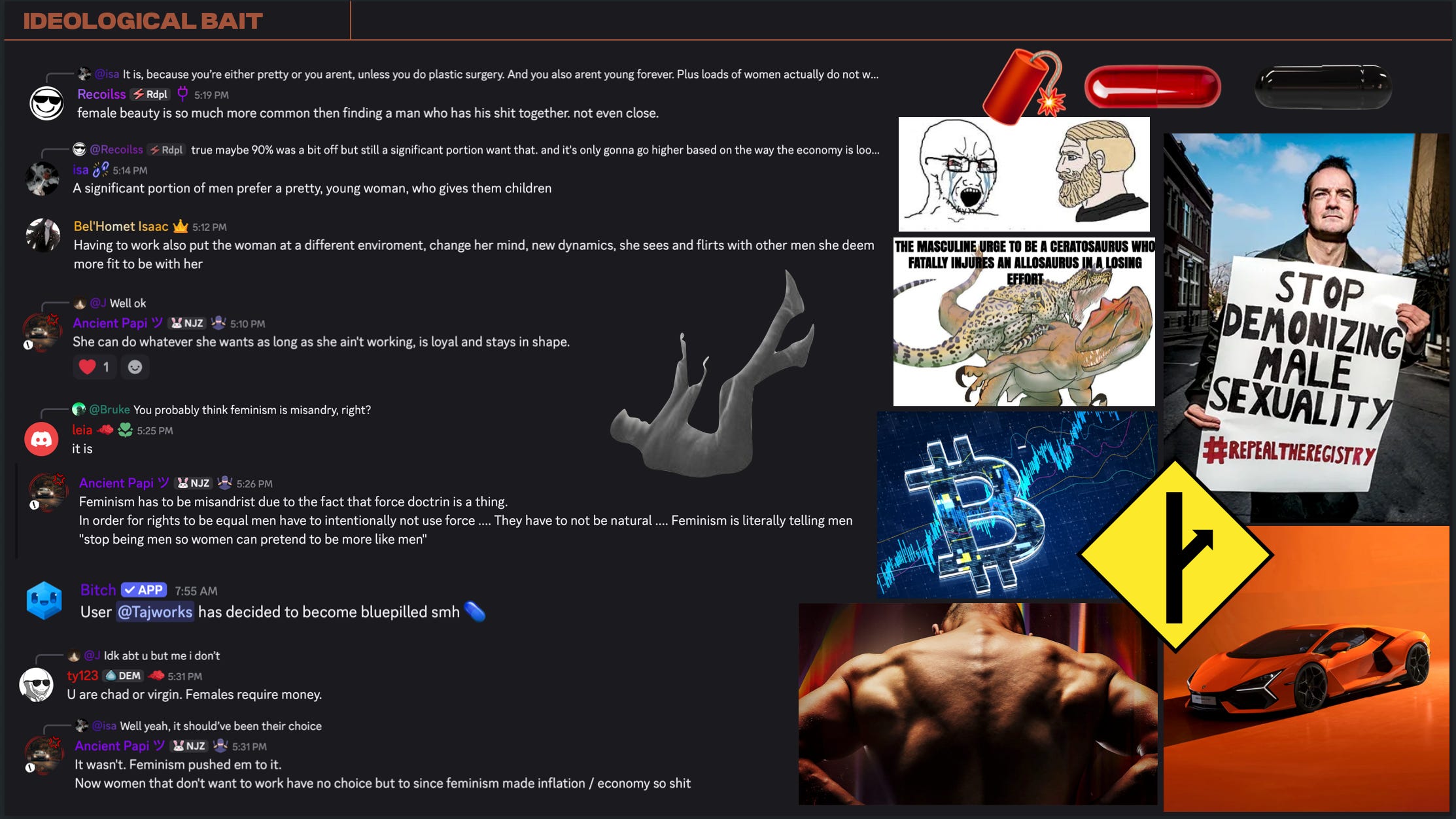
To understand it, you have to look past what’s being said, and focus on what’s being defended.
At the centre of it sits a particular kind of story: that something essential has been taken from men. This “something essential” comes in a number of guises: authority, control, respect, a stable sense of identity. What follows is a kind of fantasy and romanticised reconstruction - a past re-imagined as more coherent than it ever really was. A world where roles were fixed, hierarchies were clear, and access (to status, to work, to women) felt far more predictable.
This framing depends on a cherry-picked read of history. The freedoms women have today were not passively granted. They were fought for - often against systems that actively ostracised them. The right to vote, the advent and access to contraception, the ability to work, to own property, to leave a marriage. None of these were defaults. They were hard-won. For much of modern history, women were expected to remain within domestic roles, regardless of their personal preference or wellbeing. Contemporary culture, while far from equal, reflects a shift away from that. Women have more autonomy, greater economic participation, more latitude to define their lives outside of traditional structures. Divorce rates are higher, but this is reflection of the ability to leave situations that are unsafe or misaligned; not simply a breakdown of values.
What’s framed as male loss is really just redistribution. A movement away from fixed hierarchies towards something more negotiated. For those who were implicitly promised status within the old structure, that shift can feel destabilising. Equality, experienced from a position of default advantage, can feel like loss.
Within the fantasy of an ordered past and all the imagined structure that comes with it, women’s agency becomes inconvenient to those indoctrinated by manosphere ideology. Not because it is inherently threatening to men, but because it disrupts expectation. Women are reduced to function and utility - valued only in terms of what they provide, rather than who they are. This is rarely stated directly. Instead, it’s reframed through the language of purpose, polarity, natural roles. It’s often frames as loss (to avert), reductionist, and This selectively borrows from evolutionary psychology, and utilises self-help language. It’s a kind of moral gloss over what is, at its core, a desire for power and control over others.
Beneath all of this sits something much less ideological, and much more human: vulnerability.
Across the UK and similar contexts, the pattern is fairly consistent. Many young men are struggling - socially, economically, psychologically. Loneliness is high. Friendship networks have thinned out. Emotional expression remains constrained. Increasingly, socialisation happens in digital spaces, within systems shaped by algorithms rather than relationships. Influencers stand in for friends and performance replaces genuine connection.
At the same time, the usual markers of status feel less stable. Economic pathways are less predictable, and for some, precarious. Meanwhile, romantic success is no longer assumed, and rejection is more visible than ever before - particularly through dating platforms that quite literally quantify desirability. Porn further distorts expectations around sex. Social comparison is constant.
Within that environment, vulnerability is a baseline rather than just a passing state, yet the capacity to process it hasn’t necessarily developed alongside it. As Bell Hooks writes, “the first act of violence patriarchy demands of males is violence toward themselves.” Externalised dominance is often vulnerability that has been redirected, rather than resolved.
To actually look inward - to examine behaviour, take responsibility, and adjust accordingly - requires the ability to tolerate guilt, and more destabilisingly, shame. Psychologically, the distinction between them matters. Guilt is attached to behaviour and allows for repair with others. Shame attaches to identity and eviscerates the self. Guilt sounds like: “I did something wrong”, but shame sounds like: “there is something wrong with me.”
For men whose sense of self is organised around success, control or desirability, shame is intolerable. So the psyche does what it tends to do under pressure: it defends. Freud described this through mechanisms like projection and displacement - anything too uncomfortable to hold inside, gets shifted outside… If issues are perceived to come from external sources, the self remains intact. Blame follows the same trajectory: onto women, onto culture, onto “the system”. But the trade-off of these defences is significant. Agency starts to erode.
What this also maps onto, almost perfectly, is Karpman’s Drama Triangle: a psychological model that describes how people cycle between three roles under stress. Victim, persecutor and rescuer.
Men who discover the manosphere and are most vulnerable to its messaging firstly find themselves in the position of victim… Victims of feminism, of “hypergamy”, of a system that has supposedly stripped them of status, power and access. This legitimises their emotional experience without requiring introspection. The pain is felt and is real, but its source is externalised.
From there, the shift into persecutor is almost inevitable. If women are the cause of men’s pain, they become the target of their rage. Aggression, therefore, becomes self-justified as retaliation.
What’s more subtle is the rescuer role, which is occupied by the manosphere itself. Influencers, creators and figureheads position themselves as guides, offering men a way out: frameworks to success, or a path back to power. They promise clarity. But the “rescue” is conditional. It requires full ideological buy-in, and in doing so, it keeps men locked within the very cycle it claims to resolve.
The triangle is self-perpetuating. Each role reinforces the other. The more one feels like a victim, the easier it is to justify becoming the persecutor. The more one enacts persecution, the more one needs the system to rationalise it. And the rescuer remains necessary, because the underlying wound is never actually addressed.
What sits underneath this dynamic is not necessarily narcissism as a clinical diagnosis, but a narcissistic style. It’s notable that across contemporary research, men tend to score higher than women on traits associated with narcissism - particularly entitlement, dominance and self-enhancement. Not at pathological levels, but enough to matter culturally. Enough to shape how failure is processed, status is pursued, and critically, how threat is defended against.
This matters, because a narcissistic style is not inherently pathological. Narcissistic traits can support ambition, drive, cultivate self-belief and build resilience. They allow the individual to move through the world with a sense of agency and enable them to interact with their environment, to succeed in achieving their own objectives. But these traits rely on a degree of internal stability to remain adaptive. When that stability is compromised, they become far less flexible.
And under current conditions, those traits are being put under strain. Identity is no longer something that develops quietly over time. It’s formed in relation to others, in full view. Social media collapses the distance between lived experience and curated success. You are constantly positioned alongside others - self-surveilling, assessing, adjusting, comparing. For those already unsure of where they stand, that creates a particular kind of pressure. Not just to succeed, but to be seen succeeding.
The manosphere offers a kind of structure to that pressure. It simplifies things, so that masculinity gets organised into categories, hierarchies are made explicit and position becomes clearer. Concepts like “alpha” and “beta” provide immediate placement in a system that otherwise feels ambiguous. Ideas like “looksmaxxing” turn the body into an ongoing self-optimisation project, in pursuit of desirability. While presented as self-development, it’s about self-evaluation rather than embodiment. The individual relates to themselves from the outside.
Within this system, belonging is tightly policed. The ideology creates a clear in-group / out-group dynamic. Agreement with manosphere rhetotic signals alignment and status, and any deviation is treated as weakness or betrayal. Anyone who questions inconsistencies, contradictions or outright hostility within the rhetoric is quickly accused as being an enemy: a blue-pill cuck, a beta male, or simply a product of “woke society”. These labels aren’t incidental, they serve a psychological function. They pre-emptively shut down dissent before it can be meaningfully explored. This is how the system protects itself from scrutiny. Disagreement will not be engaged with. It’s a closed loop where only reinforcing voices are allowed in. Anything that might destabilise the belief system is exiled before entry.
Alongside this sits an overly simplified model of attraction. The widely circulated “80/20” theory - that a minority of men are selected by a majority of women - affords a clean explanation for rejection.
Within this framework, women take on a particular role. They are both the object of desire and the explanation for its absence. Their autonomy becomes obstruction. Feminism becomes something personal rather than structural. Change feels like loss. For a self that relies on external validation, that perceived loss can feel destabilising. When recognition is there, things hold together. When it isn’t, something starts to give.
What emerges isn’t stable confidence, but something more fragile. It may look assured, confident, like a winner, but it depends on reinforcement. And it’s in that instability that the manosphere really takes hold.
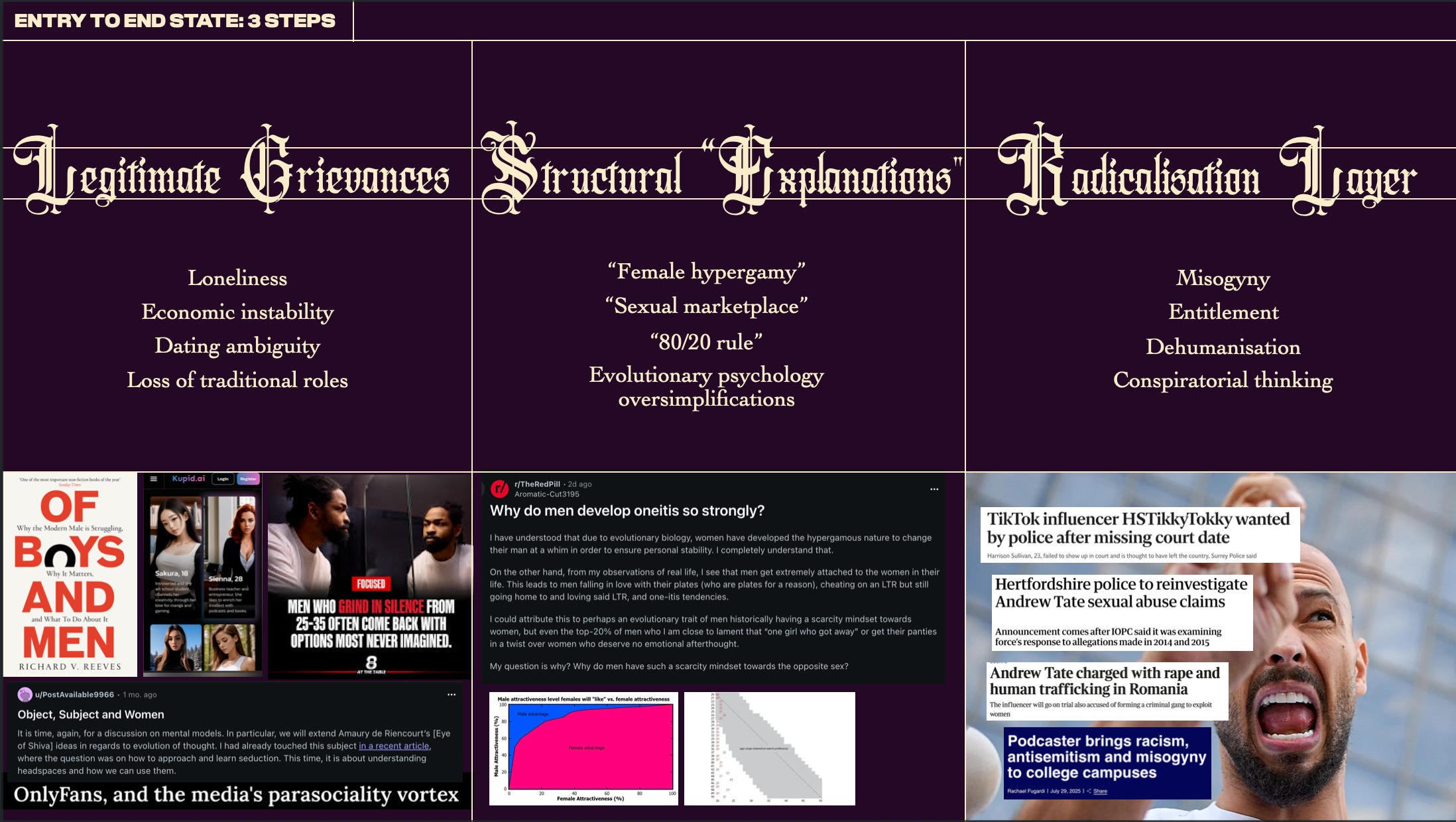
Heinz Kohut described this fragility through the concept of narcissistic injury: the psychic wound that occurs when the self is not mirrored or affirmed as expected. These injuries are often diffuse rather than acute, where repeated experiences of not being chosen, not being desired, not measuring up, add up, and create increasing levels of destabilisation. Crucially, what comes after, is narcissistic rage: a defensive reaction to the injury. Not rage as power, but rage as repair. An attempt to restore a threatened sense of self by pushing the source of injury from the inside, out. Otto Kernberg takes it further. Under pressure, the psyche splits, organising the world into binaries: strong / weak, desired / rejected, worthy / worthless. It simplifies things, but at a cost.
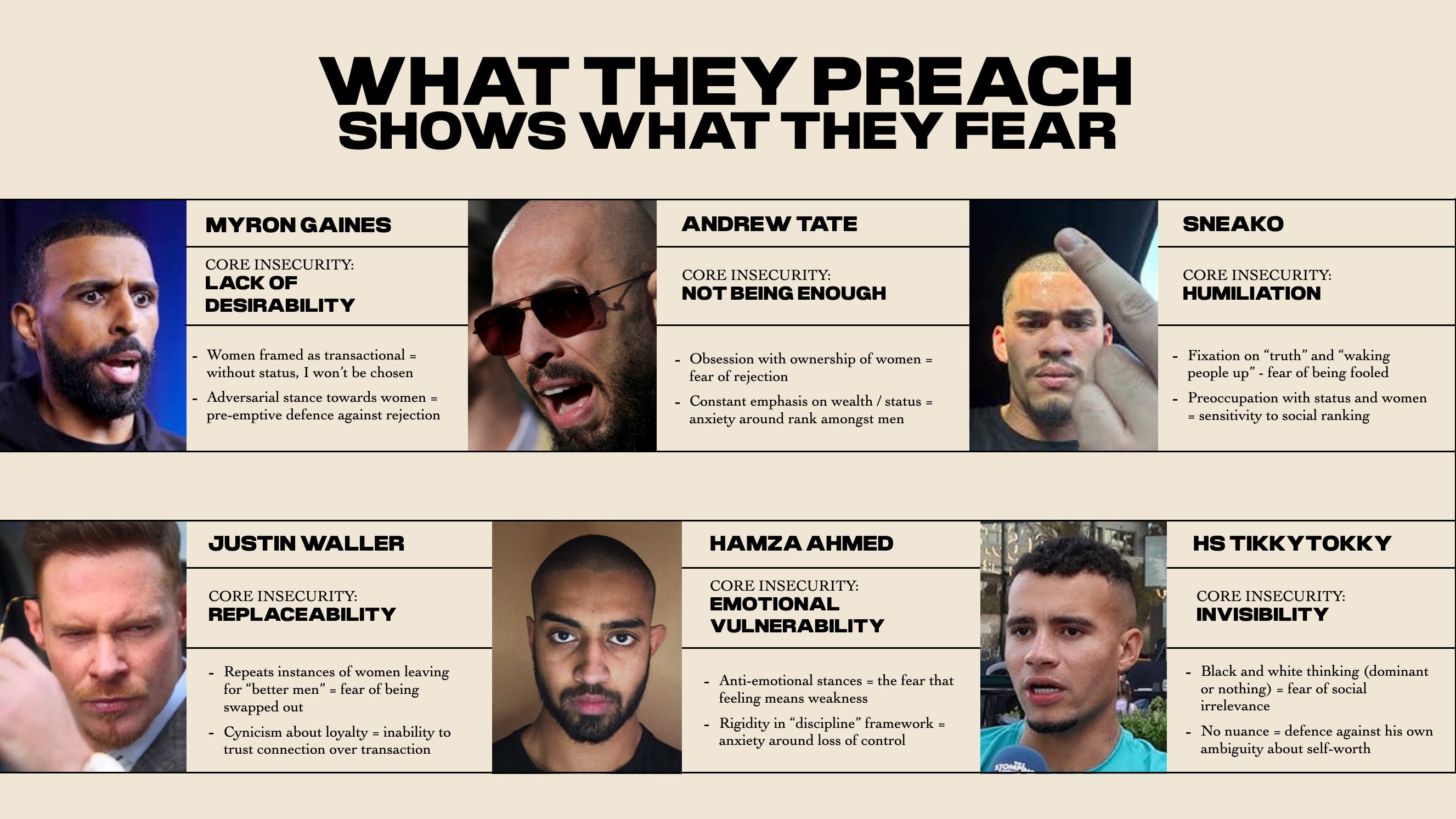
This was abundantly clear across Louis Theroux’s encounters in Inside The Manosphere. With HS TikkyTokky, there is a repeated framing of men as either dominant or negligible. You are either the one in control (physically, financially, sexually) or you are, in his words and tone, effectively invisible. There is very little space for ambiguity, development or fluctuation. Masculinity is treated as a fixed state, not a process, with zero room for development or adaptation. Similarly, Sneako positioned women as selectors and men as competitors within a zero-sum system. Within this, you are either chosen / discarded, high-value / irrelevant. The middle ground or grey area, where most real human interaction actually exists, is eradicated.
What Theroux captures, often without needing to explicitly challenge it, is the rigidity of these positions. Complexity is stripped out and people are sorted quickly into categories that are reductive but feel certain.
The men who rise within this system are exceedingly fragile, and therefore are adept at performing their defences with this characteristic rigidity. They’re fluent in dominance and the mechanics of attention. Their M.O. seems to be: convert volatility into visibility. The tragic part is: the manosphere perpetuates a system where a hierarchy stays intact, but the self doesn’t. As such, these men are - ironically - products of “the system” they claim to transcend.