
Looksmaxxing: From Man To Metric
----------------------------------------------------------------------------------------------------
Looksmaxxing is literally everywhere. It seeped into the mainstream in that way things do when they’ve already been festering in those odious corners of the internet for a while. Looksmaxxing, gymmaxxing, sleepmaxxing, whatever-the-fuck-else-maxxing started as niche self-optimisation advice within the manosphere, and has since spiralled into a full-blown way of life. The headlines are getting weirder too: teenage boys trading jaw exercises like stock tips, TikToks ranking faces with the forensic precision, Reddit subs endlessly debating bone structure like it’s destiny. AND THEN there was Clavicular - famous on the looksmaxxing scene - collapsing after reportedly overdoing it on “addy” in pursuit of the perfect, hyper-optimised self. That was the moment it tipped from disdainful to dystopian. Looksmaxxing has curdled into something else entirely: a culture that doesn’t just encourage optimisation, but demands it *at any cost*. Let’s get into it.
----------------------------------------------------------------------------------------------------
During the last few months of doomscrolling, it has become impossible to ignore the posterboys of looksmaxxing. Predictably, their faces come in a single, eerily consistent format: youthful, white, square-jawed, high-cheekboned. Add a mop of floppy hair on top, that looks accidentally perfect, and the kind of muscle definition that suggests roids, creatine and two training sessions a day.
Looksmaxxing - for those blissfully unaware - is a worldview with a central thesis: how you appear is something to be engineered, refined, and in extreme cases, forced into submission. It operates on a sliding scale, from softmaxxing (the basics: hygiene, skincare, haircare, training) to hardmaxxing (bone mashing, methmaxxing, invasive cosmetic treatments, roidmaxxing). It is self-optimisation, quite literally, on steroids. Clavicular and Androgenic sit at the sharper end of the spectrum (NB: neither name is ironic, which somehow makes it worse).
At a glance, it would appear looksmaxxing is simply about presenting better… Innocuous enough, right? Nope. It’s a mass move toward a highly specific ideal, that happens to be historically loaded. The goal is to achieve a facial structure and body that is symmetrical, sharp, lean - signalling dominance, genetic fitness and social value in immediately legible terms. The reason it feels familiar is because it edges into aesthetic purification territory. It’s giving eugenic ideals lite. Not in an explicitly outlined, ideological sense - there is no manifesto - but in its expression.
THE SELF, DISASSEMBLED
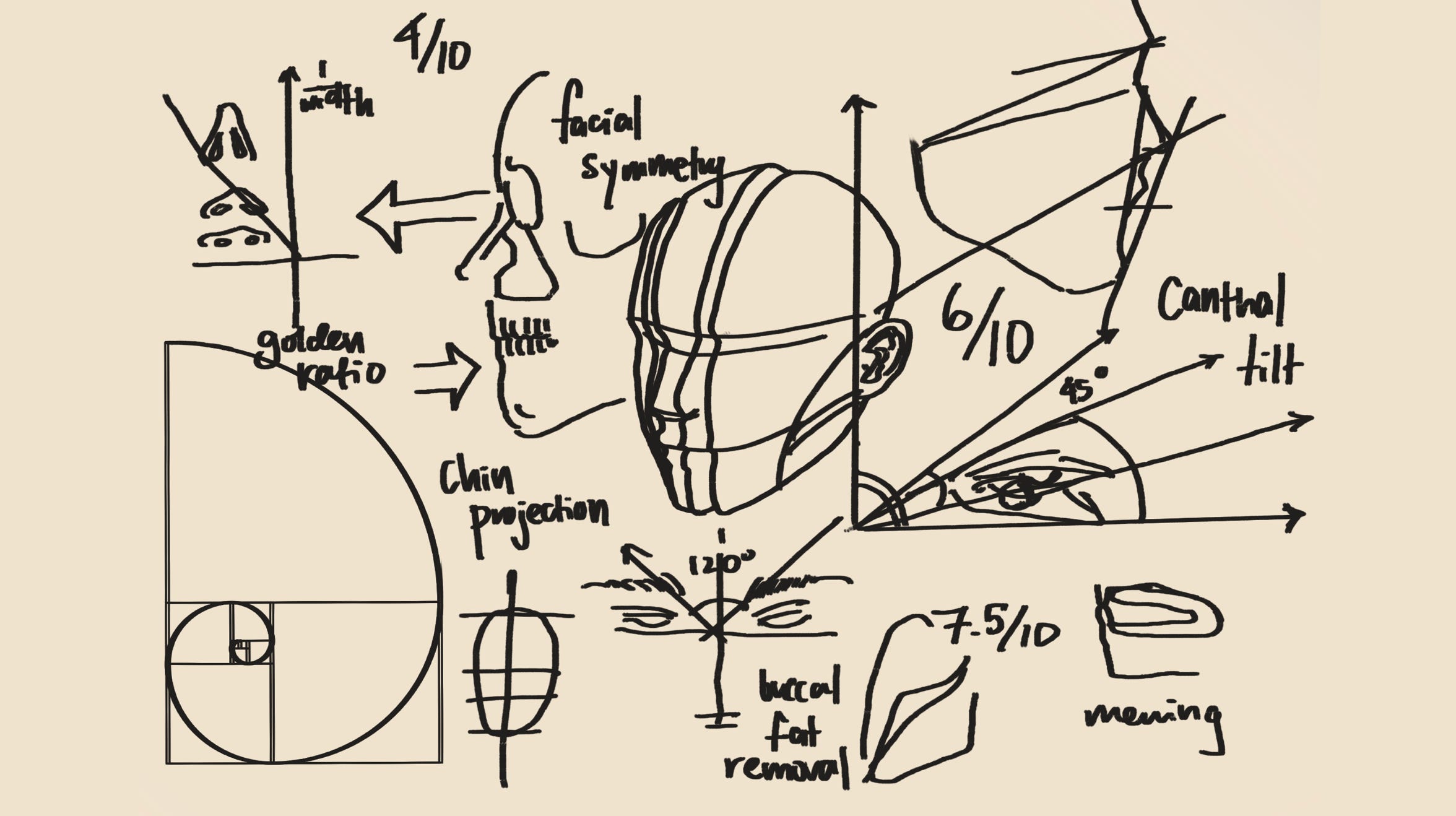
Let’s unpack the terminology first. Looksmaxxing reduces the whole self into a set of modular parts. Jawline, skin, body fat percentage, eye area, posture, voice. TikTok influencers dispense advice to build muscle mass, develop “hunter eyes”, optimise IPD and sharpen canthal tilt. This language is borrowed from gaming, finance and performance culture more broadly, and reimagines the self as a live dashboard, and the body as a machine to push towards higher and higher performance. It’s techno bro biohacking and self-optimisation culture, applied to identity.
Once the benefits of softmaxxing are experienced - better hair, brighter skin, “gains”, escalation to hardmaxxing becomes easy to justify. If the goal is optimisation, stopping at softmaxxing is irrational, and going full hardmaxxing signals commitment. It’s a slippery slope from self-improvement to self-harm.
FROM SUBJECT TO OBJECT
In these conditions, self-objectification theory begins to set in. Fredrickson and Roberts, who coined the theory in 1997, describe this as the internalisation of a consistent, evaluative gaze. It was originally developed to describe how women come to see themselves from the outside, in, and it maps cleanly onto the looksmaxxing landscape.
Under sustained evaluatiion, the self becomes something to be observed and scrutinised, rather than something to live in. As self-objectification solidifies, the self splits. One part remains embedded in experience. The other part adopts a different position: self-surveilling and adapting accordingly. Over time, this process becomes subconscious. It hums away in the background. It’s isn’t a dramatic shift - it accumulates through a slow sedimentation of tiny self-corrections and micro-adjustments. A glance that lands a beat too long. A selfie that performs a touch better than the others. An iteration of the self that seems, for reasons that are never entirely clear, to travel further, to receive more validation, encouragement or praise.
For women, this sensation is familiar. It’s been reskinned and redeployed over the course of centuries to morph with the trends du jour: from rib-clenching corsets to aesthetic tweakments. Beauty standards mutate, and the most legible right now is still ‘Instagram Face’ - as Jia Tolentino once described it - which is a face assembled from hyper-legible feminine fragments: contouring, symmetry, hyperreal. It looks like a caricature IRL because it isn’t designed for real life, it’s designed for 9:16. A real life render. That structure is highly visible online. GRWM videos, fit checks, hyper-specific morning routines - content in which the self is staged, observed and realigned to fit with idealised expectations in real time. Even something as mundane as getting dressed becomes a place to perform and be scored. This is the dynamic Casey Lewis often points to in her analysis of youth culture: trends don’t replace one another so much as they layer. Aesthetic codes shift quickly, but the underlying behaviours - self-surveillance, presentation, performance - remain constant. The medium switches up but the mechanism that underpins it holds steady.
Alongside this, there’s a countercurrent. The soft life - often framed as a backlash to girlbossing - signals a retreat from hyper-optimisation. It trades grind, performance, and short-termism for ease, comfort and sustainable effort. But some of this content has its own aesthetic codes: curated calm and signals of “effortlessness”. Even rejecting optimisation somehow operates in the same system.
Similarly, looksmaxxing’s reference group lives in the scroll. These young men compare themselves to a rolling archive of curated representations that converge into a singular, composite ideal. Constantly refreshed, rarely questioned. It comes in many forms. Glow-ups. Side-by-side jawline progressions. TikToks that draw lines across cheekbones and undereyes, as if mapping a crime scene. Rate my face apps. Subreddits roasting people (R/AmIUgly). Comments that are more like performance reviews... A stream of faces and bodies presented as benchmarks.
Looksmaxxing reads as a male-coded version of what women have been navigating for decades: the pressure to align appearance and personhood with an idealised image, and to treat their appearance as something that carries social and economic weight… None of this is new. What is new is the way it has been named and systemised.
Looksmaxxing directly articulates pressure women have been feeling for centuries. It’s a parallel experiment, conducted on a different body, with the same instruction manual.
As trends and beauty ideals shapeshift, looksmaxxing becomes a hedonic treadmill, with endlessly shifting goalposts, reframed as “progress”. Tweaks don’t resolve anything, they just lead to new “flaws” being identified. Within this, the self moves from subject, to object, to product.
LEGIBILITYMAXXING
If looksmaxxing is the face, algorithms are the DNA - invisibly determining what takes form. They reward visuals and language that land with immediacy, and identities that can be understood without expending effort. In a messy, endless feed, legible people - who are easy to decode and place - are cognitive load reducers. They don’t require the demanding graft of interpretation. They don’t slow down the scroll. And they slot neatly into existing frameworks of meaning. That neatness is what makes them valuable. Legibility, in this sense, is a kind of currency. People who are legible are easier to engage with, follow and endorse.
This is where David Elkind’s work on adolescent egocentrism comes in: he describes a phase in which teens experience acute awareness of themselves as objects of attention. They feel perceived - as if an imagined audience is always watching them - even in the absence of others. With a little more life experience, this softens and they become more grounded in themselves and anchored in experience. That softening assumes a world where observation is intermittent. But platforms create a continuous field of potential observation, so the possibility of being seen feels always-on. The audience isn’t quite there in a physical sense - it’s a screen, not a crowd - but the they are perceived as omnipresent. This gives digital imagined audiences a specific kind of psychological weight. Without a clear sense of who is watching, the mind can construct its own version of the observer, often drawing on idealised or critical standards.
Within looksmaxxing spaces, these audiences take on recognisable forms. There is:
1. THE CRITICAL IN-GROUP OBSERVER
Other men, peers, anonymous commenters. Imagined as hyper-attuned to flaws, ready to judge, rank and expose aesthetic shortfalls.
2. THE ABSTRACTED FEMALE GAZE
Positioned as the ultimate selector - it’s an imagined authority whose standards are hard to read, yet absolute.
3. THE ALGORITHM ITSELF
An obviously non-human audience that rewards legibility, shaping behaviour towards what will register quickly instead of what feels internally aligned.
And alongside these is an idealised future self - a projection that watches from ahead, always in sight yet always just out of reach.
LOOKS, AURA AND GAME
LOOKS = WHAT YOU ARE
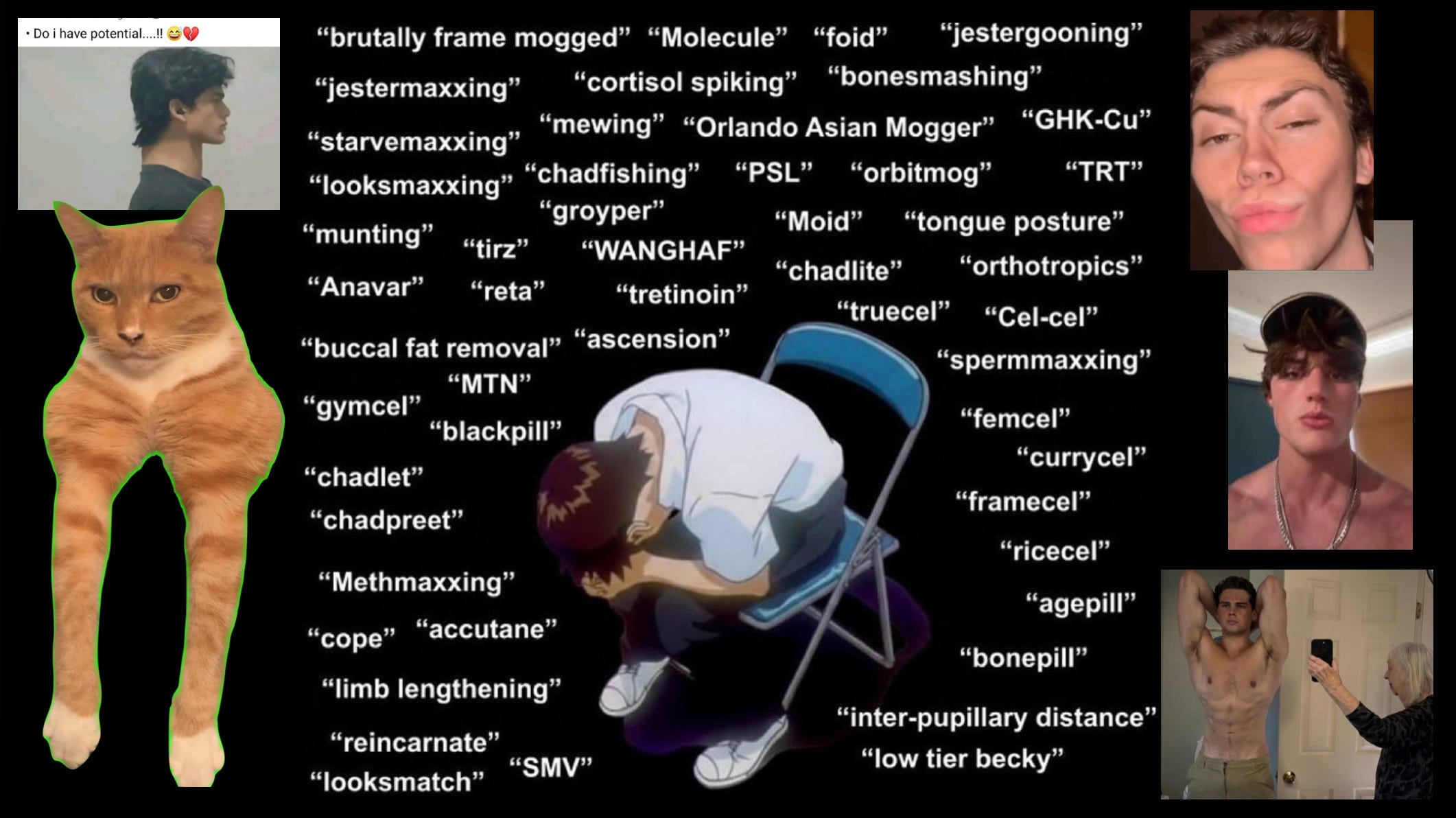
Terms like “ascension” borrow the soft, spiritual tone of manifestation culture, but underneath that crystalline veneer is something more sharp and directive: the implication that the self is unfinished. Appearance and presence can - and should - be levelled up.
This gives young men the MO to practise looksmaxxing, because it offers the promise to climb the social hierarchy. The end point of the climb is gaining “SMV” - sexual market value - a term that crudely applies stock market thinking to attraction. It transforms relationality into transaction, implying that all connections are replaceable, tradable and optimisable.
AURA = WHAT YOU OFFER
“Aura” is a bit of an anomaly. It acts as a kind of residual category, allegedly explaining why some pull beyond their league. Aura is described through a loose yet recognisable set of cues:
1. PHYSICAL CUES
Adjustments to the self, face and body are the focus of looksmaxxing, so it tracks that physical cues are the frontier... Do they have good posture? A commanding facial expression? Do they make eye contact? Are they groomed? How built is their physical stature? These are signals that point toward control, composure and social status.
2. BEHAVIOURAL SIGNALS
How do they move? How composed / reactive are they? Are they effortless or try-hard? All shorthand for self-regulation and effort level.
3. SOCIAL POSITIONING
Do others defer? Are they comfortable occupying space? Do they seek approval? Do they operate with agency? All indirect signals of status.
Underpinning the above cues are a host of familiar, aspirational psychological traits: confidence, autonomy, emotional stability, predictability. They are hard to quantify, yet treated as if they can be analysed and optimised.
GAME = WHAT YOU DO
Finally, “game” is the applied layer that brings all of this into motion. It exists downstream of:
1. INCELS AND PICKUP CULTURE
In the early 2000s, ‘The Game’ - a notoriously questionable, predatory book - landed with a radical promise: to reduce uncertainty in attraction. It claimed that openers, negging and escalation were the keys to becoming desirable. Beneath its sleazy surface, it had one compelling idea: uncertainty itself is the problem. Game proclaims that uncertainty (in the context of attraction) can be reduced, maybe even eliminated, by following a process. It reframed attraction as a sequence to run, or a code to crack. It gave incels a guide to get the girl. It now reads like a cringeworthy artefact of early internet lore. Embarrassing. Overly literal. The kind of thing referenced, if at all, with a chunky layer of irony.
The same desire for desirability and legibility has now course-corrected away from behaviour and towards biology. Incel communities pick up the thread and pull it taut. They see attraction as fixed, and governed by macro forces: genetics, the system and the imagined hypergamous thinking of women. A system to locate yourself within, rather than move through. Looksmaxxing, on the other hand, puts men in the driver’s seat of desirability. It reintroduces agency, but within tightly defined limits. Facial structure, symmetry and body composition can be adjusted in pursuit of SMV. A way of nudging position upwardly within the hierarchy - making yourself more legible to it, more competitive within it.
2. MANIFESTATION
Running parallel to incels and pickup culture, manifestation culture offered up a softer route to the same destination. It reframed desirability as something that can be manufactured internally, with enough belief, visualisation and alignment. Manifestation is less about what you actually do, more about what you hold internally. Different language. Same seductive promise. That uncertainty can be reduced, or eradicated entirely. That outcomes aren’t literally arbitrary. And rejection doesn’t have to feel personal. It’s less overtly alluring - it’s softer, but no less insidious.
Contemporary “game” borrows from both - it encourages the behaviours of pickup culture and promises the optimisation of manifestation. Then it gets filtered through the algorithm, which rewards legibility.
At the top of this system sits a very particular archetype. The so-called “giga Chad”. A control freak, highly disciplined, socially apex and confident, yet emotionally flatlining. His image is angular, muscular, and his tone is sharp and instructive. In many ways, there is an uncanny, unnerving resemblance to Patrick Bateman. Polished exterior. Interior distance.
LOOKSMAXXING: LEGIBILITY, AT ANY COST
There is no clean end point here. The slope is incremental. That’s the trap. And that’s why it works. On the face of it, looksmaxxing might present as self-improvement, but it has a built-in drift. Self-consciousness prompts self-optimisation. Optimisation turns into control. Control twists into something more extractive. At each and every stage, continuation feels justified because it feels like progression… A stricter routine. A more disciplined body. A more angular jaw. Lower body fat. Less softness. Less deviation. Less individuality. The self doesn’t disappear instantly. It’s slowly, methodically filed down to emulate what reads well. Until all that is left of the looksmaxxer is something highly legible, yet hollowed out.
There is an obvious physical cost to this. The body pushed beyond its limits. Starved, supplemented, overtrained, chemically assisted. Clavicular passing out is evidence of this. But there’s a social cost too. The person this system produces - the so-called “giga Chad” - isn’t just disciplined, he instrumentalises himself, and others. People around him are seen as signals to read, or outputs to secure. He narrows the mutuality and warmth of connection into mirrors, metrics and means. In practice, looksmaxxing will erode the conditions that make connection possible. It will continue to narrow how men relate until only performance remains.
In becoming more legible, more controlled, more optimised, he becomes harder to recognise as fully human. And that has consequences. Not abstract ones. Real ones.